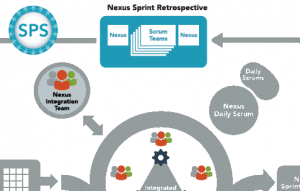

The Nexus Sprint Retrospective is the scaled version of the Sprint Retrospective event from the Scrum framework.
How does it work?
The Nexus Sprint Retrospective is a formal opportunity to plan ways to increase quality and effectiveness
across the whole Nexus. It extends the Sprint Retrospective from the Scrum framework in a few ways to accommodate the scaled environment we are now operating in.
Who should attend?
Appropriate representatives from the Scrum Teams attend the Nexus Sprint Retrospective.
The Scrum Teams will decide who is the right person or people to attend this event. As with all things in Scrum, inspection and adaption may lead to the attendees to this event changing over time.
A Scrum Master may be needed to facilitate this event. With the number of people and teams involved, the facilitation skills of the Scrum Master will be vital to ensure the event is carried out effectively and can be completed within a reasonable time box without confusion and conflict.
What is the timebox?
The Nexus framework suggests that the duration of Nexus events be guided by the length of the corresponding events in the Scrum framework. So for The Nexus Sprint Retrospective, the target for the timebox would be 3 hours for a 1-month Sprint.
Inspection and adaption may lead to this being adjusted over time as required. Depending on the number of teams in the Nexus and the level of dependencies being handled, the time required may vary significantly between Nexuses.
When and where does it take place?
The Nexus Sprint Retrospective concludes the Sprint. It should be held at a consistent time and place to ensure attendees have a clear expectation of when and where they need to be in order to take part.
What else do I need to know?
The Nexus Sprint Retrospective is the primary opportunity for the Nexus to inspect, adapt and find ways to continuously improve. Its successful use will be vital to find solutions to the additional complexity that will come from operating at scale.
The members of the Nexus will look for ways to extend and enhance the Nexus framework to create their own unique way of working at scale. This will be the right model for your organisation and will allow you to develop your product efficiently and enjoy the benefits that can come from operating at scale.
A common practice is to wrap individual Scrum Team Sprint Retrospectives with Nexus Sprint Retrospective activities before and after.
This would work as follows:
- Appropriate representatives from Scrum Team meet, identify and make transparent issues that have impacted more than a single Scrum Team.
- Individual Scrum Team hold their own Sprint Retrospective. They can use issues raised from the first part of the Nexus Retrospective as input to their team discussions and should formulate actions to address them.
- Appropriate representatives from the Scrum Teams meet again and agree on how to visualise and track the identified actions that have impacted more than a single Scrum Team.
–> Next post: How Does Scaled Professional Scrum Extend The Nexus Framework?
<– Previous post: Nexus Sprint Review
Index – Scaled Professional Scrum And Nexus – The Definitive Guide