
The Manifesto for Agile Software Development was created in 2001 by a group of visionary software developers who believed that “uncovering better ways of developing software” would require a replacement of some fundamental principles of 20th Century management.
The Agile movement they sparked values people, customers, collaboration and measurable results. It accepts the inevitability of rapid change in the modern world and provides a proven approach to deal with it.
Agile practices enable software development teams to achieve both disciplined execution and continuous innovation. Agile approaches have since been field-tested and proven in tens of thousands of organisations around the world. Agile approaches are now used by industry leaders including Google, Apple, Facebook and Amazon. It is now the default approach for developing software.
The revolutionary impact of Agile is now spreading out from the IT department and is transforming the way entire organisations operate. Marketing teams have a huge opportunity to embrace this change and deliver better outcomes and increased value to their customers.
Why Be Agile?
“The best-kept secret in business today: Agile”
–Steve Denning
Whilst building software, it is commonplace to deal with complex problems and constant change. This is now increasingly true for many parts of modern organisations. Customer demands are hard to predict and subject to constant change.
Agile enables organisations to master this continuous change. It enables people to flourish in a world that is increasingly volatile, uncertain, complex and ambiguous.
Agile Marketing
The [Marketing] industry has, unfortunately, been constructed around things like long booking deadlines or production cycles and that is what we want to change. It has to change because that is not the way the world works.”
–Keith Moor, Santander
Agile, in a marketing context, means using data to continuously source promising opportunities, create solutions to customer problems, evaluate the results, and rapidly iterate and improve. The objective being to deliver the maximum value in the minimum time and to continuously improve our ability to do so.
An Agile team is a growing, learning, adapting organism that is in constant flux in order to exploit new opportunities and add new value for customers.
Prerequisites
There are a number of prerequisites for agile marketing to work:
- Clear Goals – A marketing team must have a clear sense of what it needs to accomplish
- People – A small cross-functional team of motivated and talented people who can focus on delivering against goals.
- Sponsorship – Senior marketing leaders need to understand and support the move to Agile working.
- Infrastructure – Have sufficient data, analytics, and the right kind of marketing-technology infrastructure in place.
Culture & Characteristics
An Agile Marketing team exhibits the following behaviours:
- Continuous collaboration – The team works together daily with clear and measurable goals and a shared accountability.
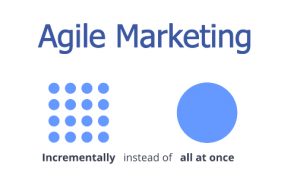
- Speed – Big initiatives are broken down into smaller ones and worked on iteratively and incrementally, delivering value early and often.
- Embracing the unexpected – The market will change and the needs of the customer will change. We accept this and make it an advantage for us.
- Data & Simplicity – We make decisions based on empirical data and seek to simplify work in all its forms wherever possible.
- Customer First – The customer is at the centre of all we do. We work closely with them in order to clearly understand what they need and work to deliver value and in each iteration.
Conclusion
Agile has proved transformative in its ability to enable businesses to create valuable and market-leading software.
The advantages of the approach are now spreading beyond IT. Adopting Agile ways of working can offer game-changing benefits to Marketing teams.