I recently finished reading Jurgen Appelo’s latest book (Human Robot Agent) and appreciated a particular section – The Four Quadrants Concept. Other models exist to explain the same idea, but I have observed that people typically struggle to make sense of them. This model is among the clearest I have encountered, so I wanted to summarise and share.
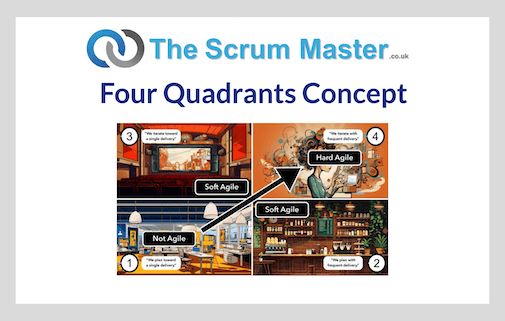
The Four Quadrants concept is Jurgen Appelo’s way of mapping how organisations approach product development and change, using two dimensions: whether work is done incrementally or as a big batch, and whether solutions are discovered experimentally or designed upfront. The intersection creates four quadrants: Planned, Serial, Original, and Agile.
The Planned quadrant is where work follows Big Design Upfront (BDUF). Organisations invest heavily in planning and designing before execution. It assumes that requirements are knowable in advance and that a linear process will succeed. While stable for routine, predictable work, it often leads to rigidity and failure when faced with uncertainty or fast-changing markets.
The Serial quadrant emphasises incremental delivery without much experimentation. It focuses on breaking work into smaller, sequential steps, delivering value continuously. This approach reduces risk and increases flow but may lack adaptability if assumptions about customer needs prove wrong. Lean manufacturing is a classic example of this quadrant.
The Original quadrant represents iterative experimentation without incremental delivery. Teams in this space generate ideas, test concepts, and explore possibilities through prototypes or pilots, but do not necessarily release value continuously. It suits environments where novelty and innovation dominate, such as research labs, creative industries, or early design stages.
The Agile quadrant combines both incrementalism and experimentalism. Here, teams iterate to learn and deliver in small increments, providing value quickly. This is the world of Scrum and Agile practices, where sprints blend discovery and delivery, enabling adaptation through feedback loops. It is most effective in complex environments where both learning and rapid value delivery are essential.
Appelo notes that many organisations transition between these quadrants. For instance, moving from Planned to Serial by adopting Lean, or from Serial to Agile by adding experimentation to incremental delivery. Some even shift from Original to Agile by breaking experimental work into small increments. He highlights six such transitions, showing that becoming “more agile” is not a single leap but a series of shifts across quadrants.
The Four Quadrants provide a lens for understanding why not all work should be managed the same way. Stable, predictable work might belong in Serial, while creative exploration thrives in Original. The Agile quadrant offers the best of both worlds, but Appelo cautions that not every environment calls for it. The value of the model lies in helping leaders and teams recognise where they are, where they should be, and how to transition strategically.
The rest of the book is worth a read as well. It explores how artificial intelligence, robotics, and digital agents are transforming the way we work, lead, and manage organisations.