
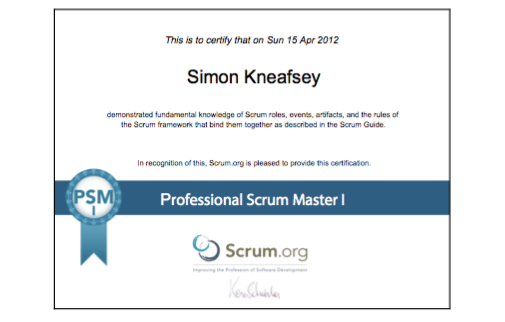
The Scrum.org Professional Scrum Master I (PSM I) assessment is a 60-minute timeboxed assessment. You need to score over 85% to pass and gain the PSM I certification. The assessment contains 80 questions in English of multiple choice type.
You decide when and where to take the assessment. You are not required to attend an assessment centre and can take it online from a location of your choosing. There is no expiration date once you have purchased the assessment attempt.
Further details on what to expect from the assessment can be found on the Scrum.org PSM I assessment page.
Here are some tips on taking and passing the Scrum.org Professional Scrum Master I (PSM I) assessment and gaining certification:
- Ideally, attend a Scrum.org Professional Scrum Master course.
- An alternative lower-cost way to gain the knowledge you need is with our Ultimate Scrum & Agile eLearning courses. Take our Ultimate Scrum eLearning Course to learn the fundamentals & our Ultimate Scrum Master eLearning Course to learn more about the Scrum Master.
- Read the Scrum Guide and get really familiar with it. This is the primary source of answers for the assessment.
- Download our Scrum 1 Pager. It’s great for reference and revision.
- Review our other Simple Guide To Scrum resources.
- Review the Scrum Glossary for quick definitions of key terms.
- Take the Scrum Open assessment a few times until you have seen all the questions and can score 100%.
- Take our Free Scrum Master I (PSM I) Practice Assessment. This offers different questions to the Scrum.org Open assessment so is an additional opportunity to test your knowledge in advance of sitting the real assessment.
- Take our paid Ultimate Scrum Master I (PSM I) Practice Assessment. This offers 500+ questions and is the best and most comprehensive practice assessment available anywhere. It is 5-star rated and has been used by thousands of people.
- Remember the Scrum Master is a coach and facilitator. They do not tell the team what to do or how to do it, except in matters relating to the Scrum framework.
When you are ready to take the assessment:
- Have the Scrum Guide, Scrum Glossary and our Scrum 1 Pager to hand and use them to look up what you need.
- Answer all the questions even if you have to make an educated guess. The assessment is not negatively marked.
- Read the questions and answers carefully. One word misread can lead you to the wrong answer.
- Don’t spend too long on each question. If unsure of an answer, note down the question number and move on. Completing all the questions in the timebox can be challenging.
- Be aware of the difference between “must” (a mandatory thing) and “should” (an optional thing).
- Make sure you select the required number of answers as the platform will not prompt you. Choosing only 1 answer on a “Pick 2” style question is a quick way to drop points.
- Come back to the hard questions at the end and use your time to think them over.
- Aim to leave time to check all your answers before the end.
- Google the question if really unsure, but be careful as this takes time and there are lots of unreliable sources out there.
You can resit the assessment if you need to, but you will need to purchase another attempt from Scrum.org. The only exception to this is if you attend a Scrum.org Professional Scrum Master course, and then fail the PSM I assessment within 14 days of completing the course. In this case, Scrum.org will provide you with a 2nd free attempt.
I hope this information will help you to pass. Let me know how you get on via the comments below and good luck!


Hi,
As per my understanding answer for this should be True but it shows Incorrect on selecting True. Could you please explain right answer.
Select True or false
The Development Team must be no smaller than 3 and no larger than 9 members
Hi Vinita,
Does Scrum mandate team size?
Regards
Simon
Ok Understood. Optimal Team size is 3-9 but it is not mandatory.
Thanks.
Hi,
Can we use the Scrum guide and browse for clarifications on same laptop on which the assessment is going on?
Hi Rahul,
The assessment is open book so yes you can. The time limit prevents this from being useful too often though so you need to know your stuff to pass.
Regards
Simon
Right. Lol they are all developers as Scrum does not differentiate team members by roles. Just need to avoid thinking of the real world as well as my team consists of all roles but should not be called so. Thanks Simon.
Hi Charley,
If you want to do Scrum, then they would need to let go of those other roles being primary. That doesn’t mean they wouldn’t have and use expertise in those specific areas. It does mean their responsibility (create a “done” Increment) is shared. This happens widely in the real world.
Regards
Simon
Hi Simon, the question of what roles are in a development team are kind of tricky. The options are Software Architect, Business Analysts, Developers and Testers. What is the odd role here?
Hi Charley,
Scrum only includes one of these 4 roles. Check the Scrum Guide and you will find the answer.
Regards
Simon
Hi
I came across this question somewhere. Can you please help me with the answer and justification
At the end of the sprint if the product owner decides that the increment should be released it signifies that the increment meets the definition of done .?? True or False
Hi Karishma,
What do you think the answer is and why?
Regards
Simon
I think the answer is false, the measure of determining if the increment is successful is if it satisfies the D0D and not what the product owner chooses to do
But then again my doubt is if the product owner chose to release it, it may mean that it did qualify through the criteria of DoD.
I apologize if I haven’t for the concepts right.
Regards
Karishma
Where did you come across this question by the way?
No need to apologise for anything.
I think it was from testtakeronline.
That makes sense. It’s not a good question. I agree with your thinking about it but I don’t think it can be answered confidently with the limited detail provided.
hi Simon,
I have some query(they are not your test questions) which I can’t really figure it out, hope you could help.
1. When does sprint duration planned ? is it In the first sprint planning?
2. Can spring duration change for every sprint? As i knew sprint duration is fixed once sprint start, how about readjust the length when sprint retrospective ?
3. Can I have 2 scrum master in one scrum team?
Hi Oktaheta,
Somer interesting questions:
1. I think you would need to do this in advance of the first Sprint starting.
2. Sprint duration can change on occasion, if inspection shows it would help. It should not be changing frequently and not each Sprint
3. Interesting question. Technically yes, in practice I suspect this wouldn’t be a good idea. Scrum requires a Scrum Master, but doesn’t explicitly cap them at 1. To prevent problems you would have to carefully plan how they would share responsibility and work. I would ask why a team would need more than 1 Scrum Master?
Regards
Simon
What are the risks of making sprint too long?
A. The product Increment may change
B. Scrum Team focus may decrease
C. Risk may increase
D. Scrum Team morale may decrease
E. Complexity may increase
Answer is C and E, but why A is not one of them?
Hi,
I don’t recognise this question as one of mine. Where did it come from?
Regards
Simon
Hi Simon,
If I am not mistaken, the question came from …
I am just want to clarify with you about the question. If this question come to your mind, what answer would you think is most accurate.
Thanks,
Regards,
Oktaheta
Hi Oktaheta,
OK. I don’t think this is a particularly good question. It wouldn’t be representative of something Scrum.org would ask.
Option A doesn’t make sense. An increment is subject to almost constant change. B, C & E may occur although this is not certain. If those things were to occur then D may also be true but I don’t see a direct link between Sprint length and morale.
Regards
Simon
This question is actually lifted from the scrum guide. The correct options are A,C &E. Refer to the scrum guide section on Scrum Events (The Sprint)
I beleave this is a misinterpretation, it’s true that there could not be sub teams, but iff the testers, etc. are adjusted als member of the team there is no problem? Correct ?
Hi stef,
Not sure exactly to what you are referring here. However, Scrum is clear that there should not be sub-teams inside a Development Team. Remember that roles and skills are different things and not to be confused.
Regards
Simon
Development teams include which role(s)
Pick All that apply
– Developers
– Software Architects
– Testers
– Business Analysts
isn’t it all? isn’t it cross functional ? Every one whichever deemed is appropriate to development teams.
Why it prompt incorrect when doing your website practice assessment ?
Hi Oktaheta,
Thank you for getting in touch.
Check the Scrum Guide and specifically the section on the Development Team. One of the bullet points explains why 3 of those options are incorrect.
I hope that helps.
Regards
Simon
The Development Team must be no smaller than 3 and no larger than 9 members.
Isn’t it true? Why it prompt incorrect when doing your website practice assessment ?
Hi Oktaheta,
Thank you for getting in touch.
This is a common miss conception among Scrum Practitioners. Team size is recommended, but not mandated by Scrum. So it is the “must” makes this statement false. Please check the Scrum Guide to see what I mean.
I hope that helps clarify this for you.
Regards
Simon
Hi Simon,
thank you for sharing. It is very helpful. I will repeat the PSMI in September. The first attempt was not successful… Score: 67 points scored (or 83.8%) out of 80 maximum points.
same thing. it is really depressing though. same mark.
Any tips on passing PSM II ? Please
Hi Mark,
Have a look at this post:
https://www.thescrummaster.co.uk/scrum/how-to-pass-the-professional-scrum-master-ii-psm-ii-assessment-from-scrum-org/
Regards
Simon
Any tips on passing PSM I ? Please
Hi,
I have sent you a message.
Kind regards,
Sam