
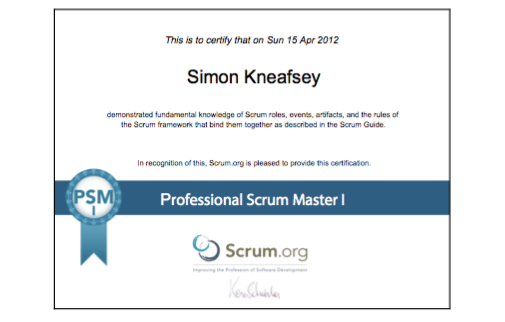
The Scrum.org Professional Scrum Master I (PSM I) assessment is a 60-minute timeboxed assessment. You need to score over 85% to pass and gain the PSM I certification. The assessment contains 80 questions in English of multiple choice type.
You decide when and where to take the assessment. You are not required to attend an assessment centre and can take it online from a location of your choosing. There is no expiration date once you have purchased the assessment attempt.
Further details on what to expect from the assessment can be found on the Scrum.org PSM I assessment page.
Here are some tips on taking and passing the Scrum.org Professional Scrum Master I (PSM I) assessment and gaining certification:
- Ideally, attend a Scrum.org Professional Scrum Master course.
- An alternative lower-cost way to gain the knowledge you need is with our Ultimate Scrum & Agile eLearning courses. Take our Ultimate Scrum eLearning Course to learn the fundamentals & our Ultimate Scrum Master eLearning Course to learn more about the Scrum Master.
- Read the Scrum Guide and get really familiar with it. This is the primary source of answers for the assessment.
- Download our Scrum 1 Pager. It’s great for reference and revision.
- Review our other Simple Guide To Scrum resources.
- Review the Scrum Glossary for quick definitions of key terms.
- Take the Scrum Open assessment a few times until you have seen all the questions and can score 100%.
- Take our Free Scrum Master I (PSM I) Practice Assessment. This offers different questions to the Scrum.org Open assessment so is an additional opportunity to test your knowledge in advance of sitting the real assessment.
- Take our paid Ultimate Scrum Master I (PSM I) Practice Assessment. This offers 500+ questions and is the best and most comprehensive practice assessment available anywhere. It is 5-star rated and has been used by thousands of people.
- Remember the Scrum Master is a coach and facilitator. They do not tell the team what to do or how to do it, except in matters relating to the Scrum framework.
When you are ready to take the assessment:
- Have the Scrum Guide, Scrum Glossary and our Scrum 1 Pager to hand and use them to look up what you need.
- Answer all the questions even if you have to make an educated guess. The assessment is not negatively marked.
- Read the questions and answers carefully. One word misread can lead you to the wrong answer.
- Don’t spend too long on each question. If unsure of an answer, note down the question number and move on. Completing all the questions in the timebox can be challenging.
- Be aware of the difference between “must” (a mandatory thing) and “should” (an optional thing).
- Make sure you select the required number of answers as the platform will not prompt you. Choosing only 1 answer on a “Pick 2” style question is a quick way to drop points.
- Come back to the hard questions at the end and use your time to think them over.
- Aim to leave time to check all your answers before the end.
- Google the question if really unsure, but be careful as this takes time and there are lots of unreliable sources out there.
You can resit the assessment if you need to, but you will need to purchase another attempt from Scrum.org. The only exception to this is if you attend a Scrum.org Professional Scrum Master course, and then fail the PSM I assessment within 14 days of completing the course. In this case, Scrum.org will provide you with a 2nd free attempt.
I hope this information will help you to pass. Let me know how you get on via the comments below and good luck!


Are the Examen questions Updates to the 2020 Version?
Hi,
Thank you for getting in touch.
Yes, the questions have been updated to the 2020 version.
Many thanks
Sam
Is it true? Question “An increment is…” expects answer from Sprint guide 2017, which is not true anymore in Sprint guide 2020
The answer is accurate and the nature of an Increment has not changed from the 2017 to 2020 Scrum Guides.
Your question about increment expects answer “The Increment is the sum of all the Product Backlog items completed during a Sprint and the value of the increments of all previous Sprints.”
That is from old 2017 definition, where increment is single per sprint with all the value of all previous sprints. Citation of 2017:
“The Increment is the sum of all the Product Backlog items completed during a Sprint and the value of the increments of all previous Sprints. At the end of a Sprint, the new Increment must be “Done,” which means it must be in useable condition and meet the Scrum Team’s definition of “Done.” An increment is a body of inspectable, done work that supports empiricism at the end of the Sprint. The increment is a step toward a vision or goal. The increment must be in useable condition regardless of whether the Product Owner decides to release it.”
But in version 2020 inkrement is not defined as “all values until now” anymore. It is defined as every new value done and integrated separatelly in that inkrement. See citation from 2020:
“An Increment is a concrete stepping stone toward the Product Goal. Each Increment is additive to all prior Increments and thoroughly verified, ensuring that all Increments work together. In order to provide value, the Increment must be usable.
Multiple Increments may be created within a Sprint. The sum of the Increments is presented at the Sprint Review thus supporting empiricism. ”
Yes, the definition of an Increment changed in the latest Scrum Guide. But the old definition is still true. It is just explained in a different way now.
So the answer to the assessment question is still valid, correct and the only correct option from the 4 options provided.
Thank you for sharing your excellent tips and tricks.
Hi Simon, thanks for this free test!
I was stumped when I got this true/false question incorrect – “Scrum master facilitates Daily scrum” . I thought the Scrum guide states that Scrum Master faciliates scrum events as needed.
Hi Sue,
Glad it was helpful.
Just because a Scrum Master may facilitate an event if needed, does not mean they must facilitate all events at all times.
Regards
Simon
Hi Simon:
It has been an interesting read thus far on this site. I take away something here – No matter what you read, always refer to the Scrum Guide for clarifications. It will be great to have uploads of your videos on YouTube as Scrum is global and people need to know and embrace it for a better and safer world.
Great Job.
Thank you Alberto. Nice to hear!
Hi Simon,
Who selects the Scrum team?
I am not able to find the answer.
Hi Reecha,
Scrum doesn’t provide a direct answer to this. Based on the Scrum values and principles, what would be the most appropriate option?
Simon
Hi Simon,
So in this case, referring “done” .. option 4 is correct.
Thanks
Maha
An Increment is…
Pick 1
• All work that has happened up to the current point in time
• All work completed up to now, where there are no bugs present
• All work that was carried out in the Sprint
• All done Product Backlog Items completed during a Sprint, plus those done in earlier Sprints
Is the option 4 correct?
Hi Maha,
Perhaps. Which of the 4 is “the most” correct and why?
Regards
Simon
Hi Simon,
As per my understanding any work that is carried out in that sprint is an increment.
Thanks
Maha
Hi Maha,
That is not quite correct. Have another read of the Scrum Guide. There are other necessary characteristics of an increment (e.g. “Done”).
Regards
Simon
Hi Simon,
So in this case, referring “done” .. option 4 is correct.
Thanks
Maha
could you pls help me with the answer.. I never got it right.. I was thinking of 1 and 3.. but its not
Hi Maha,
What is your thinking around each option?
Regards
Simon
The Development Team does not have any testing specialists in the team. They should…
Pick 2
• Produce an Increment that will be tested by a dedicated test team after the Sprint to guarantee the quality
• Request for a specialist tester to join the team and queue testing for them to do when they arrive in a later Sprint
• Quality is the responsibility of the Development team and they should undertake testing themselves to the best of their abilities
• Raise this as an impediment which may require the assistance of the Scrum Master to resolve
I believe answer to below question should be True but in test it shows False.
The Scrum Master must facilitate the Daily Scrum.
Scrum Master facilitates all events in the scrum.
Hi Vinita,
Does the Scrum Guide say the Scrum Master must facilitate all events?
Regards
Simon
Hello,
I was going over my notes on the Scrum guide recently and thought it would be a nice idea to better organize them and put them online. I found them really helpful while preparing for the PSM I exam so others might too :)
https://github.com/vpapadopou/scrum-guide-notes
Regards,
Vassilis
Hello Simon.
Could you please clarify with the below question ? I think the answer could be the following one
Management need to monitor progress on a daily basis and decide to do so by attending the Daily Scrum. What are the likely results?
Select the best 4 options
Additional facilitation may be required to keep to the time box
The Development Team may end up with less time in the Daily Scrum to re-plan their work
Management will be able to better direct the work of the Development Team
The Scrum Master may need to enforce the rule that only Development Team members participate
in the Daily Scrum
The Development Team may be less open and transparent during the Daily Scrum
The Scrum Master may need to enforce the rule that only Development Team members participate
in the Daily Scrum
how can we select 4 options here ?
Hi Kiran,
Many answers are possible to this situation. The point of the question is to select the answer which does not align with Scrum values and principles. I hope that makes sense.
Regards
Simon