
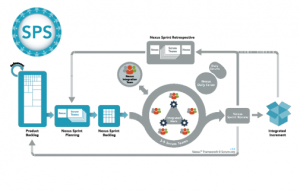

The Nexus framework extends the artefacts from the Scrum framework in a number of ways.
Product Backlog
There is a single Product Backlog for the entire Nexus and all of its Scrum Teams. The Product Owner is accountable for the Product Backlog, including its content, availability, and ordering.
At scale, the Product Backlog must be understood at a level where dependencies can be detected and minimized in advance of the actual implementation work to deliver the items in a future Sprint. This is to keep the Scrum Teams in the Nexus as autonomous and independent as possible during a Sprint. That way they can work on delivering functionality without excessive reliance on other teams which could slow work and lead to a reduced ownership by the individual teams.
This often means more work has to be done up front to analyse and decompose Product Backlog Items. This work will be done as part of Product Backlog refinement. Product Backlog items may be considered ready for the Nexus Sprint Planning event when they can be selected to be done by Scrum Teams with no or minimal dependencies on other Scrum Teams.
Nexus Sprint Goal
During the Nexus Sprint Planning event, a goal for the entire Sprint is formulated. The Nexus Sprint Goal is a single objective for the Nexus. It is the sum of all the work and Sprint Goals of the Scrum Teams within the Nexus. It creates coherence and focus for the Nexus for the Sprint by encouraging the Scrum Teams to work together rather than on separate initiatives.
Nexus Sprint Backlog
A Nexus Sprint Backlog is the composite of all Product Backlog items from the Sprint Backlogs of the individual Scrum Teams. It is used to highlight and visualise dependencies and the flow of work during the Sprint. It is updated at least daily, often as part of the Nexus Daily Scrum. The commitment for the Nexus Sprint Backlog is the Nexus Sprint Goal.
Integrated Increment
The Integrated Increment represents the sum of all integrated work completed by a Nexus. The Integrated Increment must be potentially releasable which means it must meet the definition of Done for the Nexus. The Integrated Increment is inspected at the Nexus Sprint Review.
Next post: The Nexus Integration Team –>
<– Previous post: The Nexus Framework
Index – Scaled Professional Scrum And Nexus – The Definitive Guide




This is a really good site and i am looking to do the SPS shortly. Quick question though, your description of the Nexus Sprint Backlog suggests is shows it is a composite of all the Scrum Teams PBIs. Whereby in other materials i am ready suggests it only shows PBIs that have dependencies, PBIs with no dependencies would not be displayed. Please can you confirm?
Here is how the Nexus Guide defines the Nexus Sprint Backlog:
“A Nexus Sprint Backlog is the composite of Product Backlog items from the Sprint Backlogs of the individual Scrum Teams. It is used to highlight dependencies and the flow of work during the Sprint.”
Despite what other sources claim to me it is clear that it is intended as a composite of Sprint Backlogs with the objective of helping highlight dependencies.
Probably the best free resource out there on Nexus. Reall well structured and written. Thanks for this!
Thank you for the kind words Muhammad