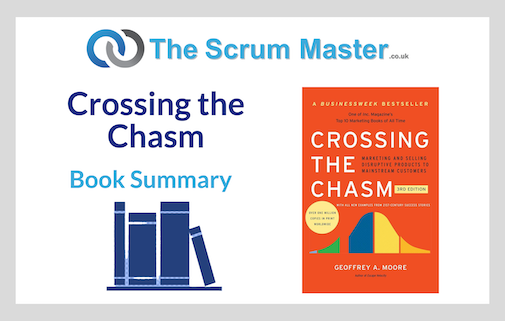
Geoffrey A. Moore’s Crossing the Chasm remains one of the most influential books on technology marketing and adoption. Originally published in 1991 and regularly updated since, it offers a powerful framework for understanding how new technologies move from early enthusiasm to mainstream success. Moore’s central idea is that innovative products often fail not because they are bad, but because they fall into a dangerous gap between early adopters and the mainstream market. This gap, or “chasm,” must be consciously and strategically crossed if a company wants to move from niche success to mass adoption.
The book provides a roadmap for doing just that, blending marketing theory, product strategy, and practical insights into how organisations can win over conservative customers after the innovators and visionaries have moved on. For anyone involved in bringing new ideas or products to market—especially in Agile, software, or product management—its lessons remain essential.
Understanding the Technology Adoption Life Cycle
At the core of Crossing the Chasm is Moore’s adaptation of Everett Rogers’ Technology Adoption Life Cycle. This model divides customers into five groups based on their openness to innovation. Innovators are the tech enthusiasts who love to experiment with new products simply because they are new. Early adopters are visionaries who see potential for strategic advantage. The early majority are pragmatists who need evidence before committing. The late majority are sceptical but will adopt once something becomes a standard, and laggards resist change for as long as possible.
Moore’s insight is that while the curve looks smooth on paper, there is a significant break between the early adopters and the early majority. Early adopters want change and are willing to take risks to achieve it, while the early majority prefer stability and proven solutions. The assumptions, messages, and product strategies that attract the first group actively repel the second. Companies that fail to recognise this divide often see early excitement evaporate when they try to sell to a broader audience.
The Nature of the Chasm
The “chasm” is the gap between visionary customers and pragmatic ones. Early adopters are motivated by potential and are comfortable with incomplete products, while the early majority want tested, reliable solutions backed by references and support. Visionaries want to be the first to implement something new, while pragmatists want to be the second or third—only after others have demonstrated success.
Moore explains that startups frequently die in this chasm because they keep trying to sell to pragmatists using the same methods that worked with visionaries. They rely on hype, vague promises, and product features that appeal to innovators’ curiosity but fail to solve specific, proven problems. Pragmatists, by contrast, need clear use cases, solid integrations, dependable performance, and trustworthy references. The transition from “early market” to “mainstream market” therefore requires a shift in mindset from experimentation to reliability.
Targeting a Beachhead Market
To cross the chasm, Moore advocates for a focused approach he calls the “beachhead strategy.” Rather than trying to appeal to everyone in the mainstream market at once, companies should concentrate all their resources on dominating a small, well-defined niche within the early majority. This niche becomes a stronghold from which the company can expand once credibility is established.
The key is to pick a market segment with a compelling problem that the product can solve completely. The goal is not just to sell a product, but to deliver a “whole product” that meets all the customer’s practical needs—including support, documentation, integration, and complementary services. When this niche sees measurable success, the reference stories generated there make it easier to win over neighbouring segments. Moore likens this to military strategy: landing on the beach, securing the position, and expanding outward from a position of strength.
The Whole Product Concept
One of the most enduring ideas in Crossing the Chasm is the concept of the “whole product.” Moore argues that early adopters are willing to fill in the gaps of an incomplete offering, but the mainstream market is not. Pragmatists expect a total solution that works out of the box and fits neatly into their existing operations.
For example, selling a new project management tool to visionaries may only require showing that it has powerful new features. Selling to pragmatists, however, means ensuring it integrates with their email systems, complies with security standards, includes user training, and offers reliable customer support. The whole product, in Moore’s view, is the combination of the core product and all the additional elements required to make it fully usable and valuable in the real world.
This concept pushes organisations to think beyond product features and consider the entire customer experience. In Agile or Scrum contexts, it aligns well with the idea of delivering a “done” increment that creates real value rather than a partial solution that leaves users to fill in the blanks.
Positioning the Product
Once the beachhead market is chosen and the whole product defined, Moore stresses the importance of precise positioning. Positioning determines how the product is perceived relative to competitors and how it fits into the customer’s mental map. Poor positioning confuses the market, while effective positioning clarifies the product’s purpose and audience.
Moore recommends creating a simple positioning statement that identifies the target customer, the product’s category, the problem it solves, and the key benefit it delivers. For example: “For project managers in software development teams who struggle to deliver on time, our product is a cloud-based planning tool that simplifies collaboration and provides real-time visibility into progress.”
The goal is to make the product’s relevance instantly clear to the target audience. Pragmatists respond to clarity, credibility, and peer validation, not hype. Effective positioning therefore involves understanding the customer’s pain deeply and articulating how your product provides a proven, low-risk solution.
Building Credibility and References
Crossing the chasm requires building trust. Pragmatists are risk-averse and prefer to buy from companies that have a track record of success with other similar customers. They rely heavily on word of mouth and case studies. This is why Moore emphasises the importance of references from within the same industry or market segment.
Rather than chasing high-profile but mismatched clients, a company should focus on winning over customers whose endorsement will carry weight with others in the same field. This creates a chain reaction of trust. Once a cluster of similar customers adopts the product successfully, it becomes the de facto standard within that niche. From there, the company can leverage its reputation to expand into adjacent markets.
In modern terms, this strategy is similar to building a strong niche community around a product before scaling to the wider market. Agile coaches, for example, might begin by serving a specific sector—such as financial technology—before expanding to adjacent industries once credibility is established.
The Role of Marketing and Sales Alignment
Moore distinguishes between marketing to early adopters and marketing to the early majority. Early adopters respond to vision, new possibilities, and transformation. Pragmatists respond to evidence, risk reduction, and practical benefits. Marketing strategies must evolve accordingly.
For early adopters, storytelling and bold claims can work. For pragmatists, marketing should emphasise case studies, measurable results, and peer recommendations. Sales processes should shift from exploratory conversations to structured, repeatable approaches focused on demonstrating value and reliability.
This shift often challenges startups because the sales team that succeeded in the early market may struggle in the mainstream phase. The company must professionalise its operations, formalise support systems, and establish predictable delivery methods. It is no longer enough to have an exciting idea; the organisation must now execute consistently and predictably.
Crossing the Chasm in Practice
Moore offers a step-by-step framework for executing a chasm-crossing strategy. First, identify and profile the target niche market. Understand the customers’ pain points, decision-making processes, and influencers. Next, define the whole product and what will be required to make it a complete solution. Then, craft a clear and credible positioning statement.
Once this is done, focus all resources on achieving a decisive win in that segment. Use the resulting customer successes as references to expand to nearby niches. Each subsequent market is chosen based on adjacency and similarity, creating a “bowling alley” effect where one success knocks over the next.
Moore’s guidance remains highly relevant in Agile product development, where iterative learning and incremental delivery are key. The principle of focusing on one market segment at a time, delivering a complete solution, and expanding based on validated learning aligns closely with Agile and Lean Startup thinking.
The Chasm and Agile Product Management
For Scrum and Agile practitioners, Crossing the Chasm provides valuable lessons about market validation and customer focus. The concept of the whole product parallels the Agile emphasis on delivering working, valuable increments. The idea of focusing on a narrow target market mirrors the Agile principle of limiting work in progress and concentrating on one priority at a time.
Moreover, Moore’s framework reinforces the importance of empirical feedback. Crossing the chasm requires listening closely to customers, testing assumptions, and iterating based on evidence—exactly the practices encouraged by Agile. Teams that apply Scrum effectively can use each Sprint Review as a checkpoint for validating whether they are still addressing the right market problem.
The book also highlights the shift from exploration to exploitation—a concept echoed in Agile scaling frameworks. Early market success comes from experimentation and innovation, while mainstream success requires operational excellence and reliability. Recognising when to make that transition is crucial for sustainable growth.
Why Many Fail to Cross the Chasm
Moore points out that most failures occur because companies misunderstand where they are in the adoption curve. They mistake early enthusiasm for broad acceptance and try to scale prematurely. They spread resources too thinly, fail to define a specific market niche, or neglect to complete the whole product.
In many cases, teams fall in love with their technology rather than focusing on solving a real customer problem. This leads to messaging that resonates with other enthusiasts but not with pragmatic buyers. The discipline to focus, to listen to the market, and to build credibility step by step is what separates companies that cross the chasm from those that vanish in it.
For Agile organisations, the same pattern applies to internal change. When introducing new practices, teams must move beyond early enthusiasts and win over the more cautious majority. The principles of focusing on a small, visible success and using it as a reference point are just as applicable to Agile transformations as they are to product launches.
Lasting Impact
Crossing the Chasm remains a vital resource more than three decades after its release because its core message transcends technology. It is about human behaviour and how people adopt change. Whether you are marketing a software product, an Agile methodology, or a new organisational idea, you must recognise that different groups embrace change at different speeds and for different reasons.
Moore’s framework offers a pragmatic way to navigate that journey. It teaches that success is not about selling harder or shouting louder but about understanding who your customers are, what they need, and how to help them feel safe in choosing you. Crossing the chasm is ultimately an act of empathy, strategy, and disciplined execution—the hallmarks of great product and Agile leadership.