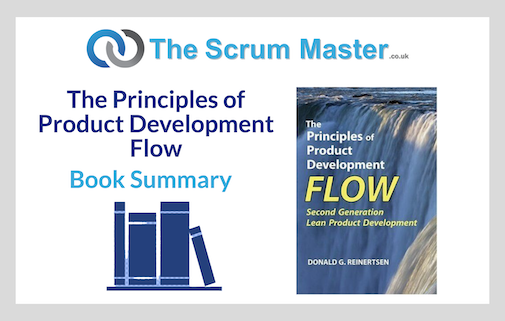
Donald G. Reinertsen’s The Principles of Product Development Flow: Second Generation Lean Product Development is a powerful guide for anyone seeking to improve how products are created and delivered. Unlike many traditional management books that focus on rigid processes and high-level theory, Reinertsen’s work is grounded in practical economics, systems thinking, and flow efficiency. His central message is simple but transformative: managing product development as a flow system can dramatically increase speed, reduce waste, and deliver greater value to customers.
Reinertsen challenges the traditional “batch and queue” approach of large-scale product development and shows how applying lean principles from manufacturing, adapted for the uncertainty of knowledge work, leads to better results. He introduces a series of principles rather than prescriptive rules, encouraging organisations to think economically, adaptively, and empirically.
From Manufacturing to Product Development
Lean principles originally emerged in manufacturing, where the goal is to reduce waste and improve efficiency in predictable processes. However, Reinertsen argues that product development is a fundamentally different type of work. Manufacturing deals with tangible, repeatable activities, while product development is about creating knowledge and solving uncertainty. In manufacturing, variability is the enemy; in product development, variability is a source of innovation.
This distinction matters because applying manufacturing-based lean techniques directly to development can cause harm. For example, excessive standardisation or attempts to eliminate all variability can crush creativity and slow learning. Reinertsen’s solution is to use flow-based principles suited for high-variability, high-uncertainty environments. The focus shifts from controlling people and outputs to managing queues, flow rates, and decision-making policies that enable faster and more reliable delivery.
The Economics of Flow
One of Reinertsen’s most valuable contributions is reframing product development as an economic problem. He introduces the concept of cost of delay — a quantifiable measure of how much value is lost when a product or feature is delayed. By understanding and communicating cost of delay, teams can make better prioritisation and scheduling decisions.
Traditional project management treats all work as equal and focuses on completing tasks efficiently. Reinertsen flips this perspective: what matters is not task completion but value delivery over time. A project that finishes later but delivers higher value may be economically superior. Similarly, a small feature that reduces customer churn or accelerates sales might have a greater economic impact than a large feature that takes longer to deliver.
This economic view changes how we think about queues and utilisation. High utilisation may appear efficient but actually increases lead time and reduces responsiveness. Reinertsen uses queuing theory to show that when systems operate near full capacity, even small variations in demand cause long delays. Reducing utilisation — by creating slack and smaller batch sizes — can improve overall flow and speed up delivery, despite appearing less “efficient” in a traditional sense.
The Power of Decentralised Control
Reinertsen also highlights the limitations of centralised decision-making in complex systems. In large organisations, decisions often get delayed as information travels up and down hierarchy chains. This delay increases risk and slows progress. Instead, he advocates for decentralised control — empowering those closest to the work to make decisions using clear economic frameworks.
When teams understand the economics of their work — the cost of delay, expected value, and trade-offs — they can make smarter decisions without waiting for managerial approval. This not only speeds up development but also creates a more adaptive organisation that can respond to change.
For Scrum Teams, this resonates deeply. Empowering developers to make decisions about how to best deliver value, based on clear goals and priorities, aligns with the idea of self-management. Product Owners, too, benefit by understanding and applying economic thinking to backlog prioritisation.
Managing Queues and Batch Sizes
A key part of Reinertsen’s argument is that queues are the invisible enemy of flow. Queues of work items — features waiting for review, testing, or approval — hide delays, increase lead times, and reduce predictability. Unlike manufacturing, where inventory queues are visible, in product development queues are hidden in backlogs, approval processes, and overloaded people.
The solution is to make queues visible and actively manage them. Reinertsen encourages teams to measure queue sizes and use them to predict delays. Reducing batch sizes — the amount of work released or handed over at one time — helps smooth flow and reduces variability. For example, delivering smaller features more frequently reduces risk, increases feedback, and allows faster learning.
This principle underpins modern agile and DevOps practices such as continuous delivery and short sprint cycles. Smaller batches make it easier to spot problems early, adapt to change, and get value into the hands of users faster.
Feedback Loops and Learning
Reinertsen insists that fast, frequent feedback loops are essential for product development flow. Because product development is about learning, delays in feedback lead to poor decisions and rework. Long feedback loops allow problems to grow unnoticed, increasing the cost of fixing them.
He suggests designing systems that provide feedback as early and as often as possible. Prototypes, simulations, customer tests, and automated builds are all mechanisms to accelerate feedback. This approach mirrors Scrum’s iterative nature, where each sprint provides an opportunity to inspect and adapt.
The shorter the feedback loop, the more a team can learn about what works and what doesn’t. Over time, this learning compounds, creating a powerful competitive advantage. Reinertsen’s emphasis on empiricism echoes the foundations of agile — making decisions based on evidence rather than assumptions.
Variability as a Source of Innovation
Traditional management thinking views variability as a problem to be eliminated. Reinertsen challenges this mindset by arguing that variability in product development is both inevitable and desirable. The goal is not to remove variability but to manage it intelligently.
In creative work, variability represents experimentation — the testing of different ideas and approaches. Without it, there can be no innovation. Reinertsen explains that variability should be preserved where it drives learning and reduced where it adds no value. For example, variability in design exploration is good, but variability in testing or deployment processes should be minimised.
Teams should use economic reasoning to decide where variability is valuable. This encourages a culture of informed experimentation, where teams can explore new options but understand the trade-offs involved.
The Importance of Flow Efficiency
One of the most misunderstood concepts in product development is the difference between resource efficiency and flow efficiency. Resource efficiency focuses on keeping people busy. Flow efficiency focuses on keeping work moving.
In many organisations, managers strive to achieve 100% utilisation of people, believing it maximises productivity. In reality, this creates massive queues and delays, because everyone is too busy to handle new work or resolve problems quickly. Reinertsen argues that idle time in people can be acceptable if it reduces idle time in work.
By prioritising flow efficiency, teams deliver value faster and respond better to change. For example, having a developer available to help when a blocker arises can dramatically reduce lead times compared to a system where everyone is fully booked.
Policies and Local Decision Rules
Reinertsen proposes using explicit decision policies rather than top-down directives. These policies give teams clear guidance for making trade-offs in uncertain conditions. Examples include prioritising work based on cost of delay, controlling queue sizes, or setting rules for batch sizes.
By codifying good decision-making principles, organisations can ensure consistent behaviour without relying on constant management intervention. This aligns closely with agile values, where principles guide behaviour instead of rigid processes.
One practical example is the use of Weighted Shortest Job First (WSJF), a prioritisation method that balances cost of delay and job duration. WSJF enables teams to make economically sound decisions about which features to develop next, optimising flow and value delivery.
Managing Risk and Uncertainty
Reinertsen points out that uncertainty is not something to fear but to embrace. Trying to remove all uncertainty leads to over-planning and rigidity. Instead, teams should design their systems to handle uncertainty dynamically.
This includes using incremental funding models, adaptive planning, and short cycles that allow for course correction. The faster a team can detect and respond to unexpected information, the more resilient it becomes. Reinertsen compares this to evolutionary processes — small, frequent adaptations outperform large, infrequent ones.
In practice, this means avoiding big-bang projects and focusing instead on iterative delivery. Each iteration provides data that reduces uncertainty and informs better decisions. This approach reduces risk while maintaining flexibility.
Applying the Principles in Practice
Reinertsen’s work can feel abstract at times, but its application is highly practical. For agile practitioners, his principles reinforce and extend many of the ideas behind Scrum and Lean.
Teams can start by measuring flow — tracking lead time, cycle time, and queue sizes — to make problems visible. Next, they can estimate and use cost of delay to guide prioritisation. Reducing batch sizes, creating slack, and shortening feedback loops are all actionable steps that improve performance.
At the organisational level, leaders can support flow by empowering teams, aligning around economic objectives, and removing systemic constraints that create bottlenecks. The focus should be on enabling faster learning and decision-making, not enforcing control.
The key takeaway is that flow is not just a process improvement technique but a new way of thinking about how organisations create value. It shifts the focus from output to outcomes, from efficiency to adaptability, and from control to empowerment.
A New Way to Think About Product Development
The Principles of Product Development Flow remains one of the most insightful and challenging books on product development. Reinertsen provides the intellectual and practical foundation for applying lean and agile thinking at scale. His ideas help teams move beyond superficial process adoption and instead focus on the underlying economics and dynamics of how value flows through a system.
For anyone working in product management, software development, or organisational transformation, this book is a must-read. It bridges the gap between theory and practice, giving leaders and teams the tools to think more clearly about complexity, flow, and value.