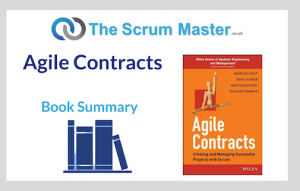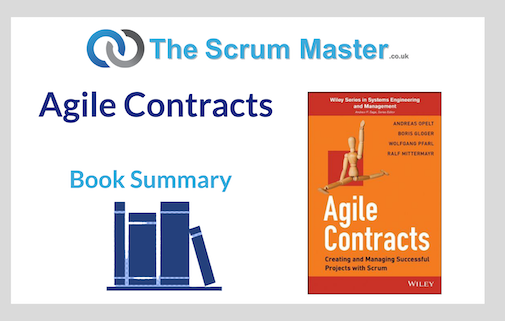
Agile projects thrive on collaboration, flexibility, and adaptability, yet traditional contracts are often rigid, adversarial, and ill-suited to support the dynamic nature of Agile delivery. “Agile Contracts: Creating and Managing Successful Projects with Scrum” by Andreas Opelt, Boris Gloger, Wolfgang Pfarl, and Ralf Mittermayr explores how contracts can evolve to fit Agile principles. The book provides practical frameworks for building trust-based, outcome-oriented agreements that encourage collaboration rather than conflict. For organisations struggling to align procurement and legal processes with Agile delivery, this book offers both a philosophical shift and a practical toolkit for change.
Why Traditional Contracts Fail Agile Projects
The authors begin by examining why traditional fixed-scope contracts often undermine Agile projects. Conventional contracts focus on deliverables, timelines, and penalties, assuming that every requirement can be defined upfront and change is a failure of planning. Agile, by contrast, recognises that uncertainty is inevitable and that customer needs evolve as learning occurs.
When Agile projects are forced into traditional contractual models, tensions quickly emerge. The customer may push for maximum scope, while the supplier tries to protect margins by limiting changes. This leads to defensive behaviour, strained communication, and reduced innovation. The book argues that such contracts promote a win-lose mindset where success is measured by compliance with the contract rather than value delivered.
Instead of trying to eliminate uncertainty through documentation, Agile contracts seek to manage it through collaboration, transparency, and shared goals. This shift requires new forms of agreements that balance flexibility with accountability.
The Core Principles of Agile Contracting
The authors outline several guiding principles that distinguish Agile contracts from traditional ones. First, they emphasise partnership over control. Both parties share responsibility for achieving the desired outcomes rather than simply delivering outputs. Second, the contract should enable change rather than constrain it. Adjustments to scope or priorities should be seen as natural responses to learning, not breaches of agreement.
Third, Agile contracts should promote transparency. Mechanisms such as regular reviews, shared product backlogs, and joint retrospectives create visibility into progress and challenges. Fourth, they encourage trust, supported by clear communication and aligned incentives. The relationship should feel like a joint venture, not a battle for control.
Finally, Agile contracts should align financial incentives with business outcomes, not just effort or time spent. The goal is to motivate the supplier to maximise value for the customer, rather than merely to complete tasks.
The Role of Trust and Collaboration
Trust is at the centre of every successful Agile contract. The authors stress that while legal frameworks matter, human relationships drive results. Without mutual trust, even the most carefully drafted contract will fail to produce the desired collaboration.
Trust develops through openness, shared understanding, and predictable behaviour. This means being transparent about risks, capabilities, and expectations from the start. Regular Scrum events, such as Sprint Reviews and Retrospectives, serve as checkpoints where both sides can inspect progress and adapt plans. These events reduce the need for formal change requests and promote continuous alignment.
The book also discusses the importance of cultural fit. Some organisations may claim to want Agile contracts but still behave in command-and-control ways. For Agile contracting to succeed, both customer and supplier must embrace iterative delivery, shared ownership, and learning from feedback.
Contract Models for Agile Projects
The authors introduce several models for structuring Agile contracts. The most traditional model is the fixed-price contract, which is sometimes required by procurement departments. The book explains how even fixed-price contracts can incorporate flexibility by defining scope in terms of high-level goals rather than detailed features, and by including mechanisms for revising priorities as the project evolves.
Another approach is the target-cost contract, where both parties share the risks and rewards. The customer and supplier agree on a target budget and share any cost overruns or savings according to predefined ratios. This model encourages collaboration to optimise efficiency without sacrificing quality.
A third model is the time-and-materials contract with a variable scope, which gives the customer control over prioritisation and funding on an ongoing basis. This aligns closely with Scrum principles, as it allows the customer to stop the project when sufficient value has been delivered.
The authors also explore hybrid models that combine elements of different structures. For instance, a contract might begin as time-and-materials for an initial discovery phase and transition to a target-cost model once the product vision is clearer. The key is to design the contract to support collaboration and continuous adaptation.
Aligning Contracts with Scrum
Scrum provides a natural foundation for Agile contracting because it includes built-in mechanisms for transparency and inspection. The Product Backlog serves as a living document that captures evolving requirements. Sprint Reviews demonstrate progress through working increments, while Retrospectives allow both sides to reflect on process improvements.
The book explains how these Scrum events can be integrated into contractual frameworks. For example, payment milestones can be tied to completed sprints rather than fixed deliverables. Acceptance criteria can be linked to the Definition of Done, ensuring that quality standards are consistently applied.
The contract can also reference key Scrum roles and responsibilities. The Product Owner represents the customer’s interests, the Scrum Master supports the process, and the Development Team focuses on delivering value. By explicitly acknowledging these roles, the contract reinforces shared accountability rather than hierarchical control.
Managing Risk in Agile Contracts
One of the biggest concerns for both sides in an Agile agreement is risk. Traditional contracts try to allocate risk through clauses that define liability and penalties. Agile contracts approach risk differently, aiming to minimise it through early delivery, constant feedback, and transparency.
The authors show how shorter feedback cycles reduce uncertainty by allowing issues to be identified and addressed early. For example, by demonstrating working software at the end of each sprint, both sides can confirm progress and adjust plans before risks escalate.
Risk-sharing mechanisms also play an important role. In target-cost models, both sides have a financial stake in project success. In time-and-materials arrangements, the customer reduces risk by retaining control over budget allocation and priorities.
The book also suggests that performance indicators should focus on outcomes rather than compliance. Measures like customer satisfaction, team velocity trends, and business value delivered provide a more accurate reflection of success than rigid adherence to scope or timelines.
Legal Considerations and Practical Clauses
While Agile contracts are based on collaboration and trust, they still need to provide legal clarity. The authors offer practical advice for drafting contracts that protect both parties without stifling agility. Key clauses should cover areas such as intellectual property rights, confidentiality, liability, and termination, but they should do so in a way that supports the Agile mindset.
For example, instead of specifying a detailed list of deliverables, the contract can define objectives and high-level acceptance criteria. Change management clauses should acknowledge that scope is expected to evolve, with agreed mechanisms for re-prioritisation rather than formal change requests.
Payment terms can be linked to iterative progress rather than a single final delivery. This ensures that the supplier is rewarded for incremental value creation while the customer retains flexibility to adapt the project’s direction.
The book also discusses dispute resolution. Agile contracts encourage resolving conflicts through collaboration first, escalating only if necessary. Some organisations use joint steering committees or mediation processes to maintain trust and prevent legal escalation.
The Procurement Challenge
One of the most significant barriers to Agile contracts is traditional procurement practices. Many procurement departments are still structured around fixed-price, fixed-scope models, designed for predictable manufacturing or construction projects rather than software development.
The authors suggest a cultural shift in how organisations approach procurement. Instead of focusing solely on cost, procurement teams should evaluate suppliers based on collaboration potential, Agile maturity, and ability to deliver business outcomes.
Request for Proposal (RFP) processes can be redesigned to encourage dialogue rather than rigid bidding. For instance, potential suppliers could be invited to run short pilot sprints to demonstrate their approach before a full contract is awarded. This helps build confidence and trust early in the relationship.
Building Long-Term Partnerships
Agile contracts work best when they are part of a longer-term relationship rather than a one-off transaction. The authors encourage organisations to develop strategic partnerships where both sides invest in shared learning, improvement, and success.
Such relationships allow for continuous adaptation of both the contract and the collaboration model. Over time, this reduces legal friction and increases delivery efficiency. For suppliers, long-term partnerships offer stability and opportunities to innovate. For customers, they provide higher value through sustained alignment and reduced transaction costs.
The book presents real-world examples of organisations that have adopted Agile contracts successfully. These case studies illustrate how flexible agreements, supported by transparency and shared incentives, can transform vendor relationships from adversarial to collaborative.
The Future of Agile Contracting
The authors argue that Agile contracts represent the next stage of evolution in project management and procurement. As more organisations embrace Agile delivery, the need for supportive contractual frameworks will continue to grow.
Legal and procurement professionals are beginning to recognise that the old models no longer fit a world of rapid change and uncertainty. Agile contracts demonstrate that flexibility and accountability are not opposites; they can coexist within a framework built on trust, transparency, and shared goals.
Ultimately, Agile contracting is about enabling successful outcomes rather than enforcing compliance. It aligns legal and commercial structures with the principles of Agile delivery, allowing both sides to focus on value rather than paperwork. By adopting the models and principles outlined in this book, organisations can unlock the full potential of Agile collaboration and build stronger, more resilient partnerships.
https://www.amazon.co.uk/Agile-Contracts-Creating-Managing-Successful/dp/3642199119?tag=thescrummaste-21