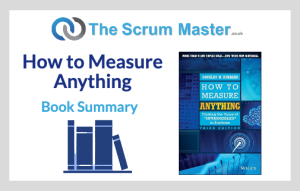
Douglas W. Hubbard’s How to Measure Anything: Finding the Value of Intangibles in Business challenges one of the most common assumptions in decision-making — that some things cannot be measured. From employee morale and customer satisfaction to innovation and risk, organisations often dismiss key factors as “immeasurable” or “too subjective.” Hubbard argues that this belief is not only wrong but dangerous. Everything that matters in business can be measured, and once measured, it can be improved.
The book combines practical statistics, decision theory and clear logic to show that measurement is not about achieving perfect precision but about reducing uncertainty. Hubbard’s methods help decision-makers clarify what they need to know, gather meaningful data efficiently and make better, evidence-based choices. His approach is especially useful for leaders working in complex environments such as product development, agile teams or project management, where uncertainty is unavoidable but manageable.
The Myth of the Immeasurable
At the heart of the book lies a simple but profound insight: measurement is about reducing uncertainty, not eliminating it. Many managers dismiss certain things as intangible because they confuse measurement with precision. Hubbard dismantles this misconception by redefining measurement as “a set of observations that reduce uncertainty where the result has value.”
In other words, to measure something does not mean producing an exact number. It means gathering enough information to make a better decision than before. Even rough estimates or partial data can provide significant value if they guide choices in the right direction. For example, a product manager may not know the exact return on investment of a new feature, but even a rough estimate can help decide whether to pursue it or not.
Hubbard explains that everything is measurable because everything has observable effects. If something influences outcomes, it can be observed and quantified in some way. For instance, “employee engagement” might seem abstract, but its impact on productivity, retention or customer satisfaction can be measured indirectly. By reframing measurement as learning rather than perfection, Hubbard removes the fear that often paralyses decision-makers.
Understanding What to Measure
The first step in effective measurement is clarifying what question you are trying to answer. Many organisations collect vast amounts of data but fail to link it to meaningful decisions. Hubbard’s approach starts with identifying what he calls the “decision context” — the specific choice that measurement is meant to inform.
For example, rather than vaguely measuring “customer satisfaction,” a business might focus on a decision such as “Should we invest more in customer support?” The measurement then becomes about reducing uncertainty around the value of that investment. By tying measurement directly to decisions, teams avoid wasting effort on irrelevant or overly detailed metrics.
This focus on decision-making aligns closely with agile principles, where feedback loops and empirical evidence guide adaptation. In both contexts, the goal is not to measure everything but to measure what matters most for learning and improvement.
The Value of Information
One of the book’s key contributions is the concept of the “value of information.” Hubbard introduces a practical method to determine whether collecting more data is worth the effort. The idea is simple: if new information is unlikely to change your decision, it has little value. But if it could shift your choice or improve your confidence significantly, it is worth pursuing.
This concept prevents the common trap of analysis paralysis, where teams spend excessive time and resources collecting data that adds little value. Hubbard shows that even a small reduction in uncertainty can have huge decision-making benefits when uncertainty is high. Conversely, when uncertainty is already low, further measurement yields diminishing returns.
By quantifying the value of information, managers can prioritise what to measure and how much effort to invest. This approach helps allocate measurement resources efficiently, especially in fast-paced agile or product environments where time and focus are limited.
Calibrating Estimates
Humans are notoriously poor at estimating uncertainty. We tend to be overconfident, giving narrow ranges for uncertain quantities, or too vague, offering unhelpful answers like “it depends.” Hubbard addresses this by teaching how to become a “calibrated estimator.”
Calibration means learning to express uncertainty in a way that matches reality. For example, if you give a 90% confidence range for an outcome, it should be correct about nine times out of ten. Through practice, people can dramatically improve their estimation skills without sophisticated statistics. Hubbard includes exercises that train individuals to better gauge probabilities and express confidence intervals accurately.
Calibrated estimation is a valuable skill for anyone working in Scrum or agile product management. Whether estimating story points, sprint capacity or business value, calibrated estimators provide more realistic forecasts. Over time, this builds trust and credibility, reducing the gap between expectations and delivery.
Simplifying Complex Measurements
Hubbard rejects the idea that only large data sets and advanced models produce reliable insights. Instead, he demonstrates how simple methods can yield powerful results. He introduces techniques like random sampling, controlled experiments and Bayesian updating, explaining them in plain language.
A core theme is that even small samples can dramatically reduce uncertainty. For instance, if you want to estimate the average time users spend on your product, you don’t need to observe thousands of sessions. A small, random sample can provide a reliable estimate if done correctly. Hubbard reminds readers that “you have more data than you think,” because relevant information often already exists in some form — it just needs to be recognised and interpreted.
He also advocates the use of proxy measures, where indirect indicators provide insights into seemingly intangible factors. For example, rather than trying to measure “team morale” directly, one might track absenteeism, turnover rates or employee referrals as proxies. By combining small, focused observations, teams can make informed decisions without overwhelming analysis.
Overcoming Resistance to Measurement
Hubbard recognises that many professionals resist measurement for cultural or psychological reasons. Some fear that measurement will expose weaknesses or limit creativity. Others believe that quantifying complex issues oversimplifies reality.
He argues that these fears usually stem from misunderstanding. Measurement does not replace judgment; it improves it. When used correctly, it informs intuition rather than contradicting it. The goal is not to reduce human insight to numbers but to support it with evidence.
Hubbard advises leaders to start small, measuring one or two key uncertainties that directly affect an important decision. Early wins help overcome scepticism and demonstrate the practical benefits of a data-informed approach. Once people see that measurement clarifies rather than constrains decision-making, cultural resistance fades.
Risk, Uncertainty and Decision-Making
A major strength of the book lies in its treatment of uncertainty and risk. Hubbard explains that risk is not the enemy — unmanaged risk is. By quantifying uncertainty, organisations can make more confident and transparent decisions about trade-offs.
He introduces basic probabilistic modelling techniques that show how different outcomes might occur and how likely they are. These models allow decision-makers to see not just the most likely scenario but the range of possibilities and their probabilities. This approach helps avoid the “single-point forecast” problem, where teams plan based on one assumed outcome and are caught off guard when reality differs.
In practice, agile teams can apply similar principles when planning releases or managing product risk. For example, rather than committing to a fixed delivery date, teams can express delivery forecasts as probability ranges. This transparency sets more realistic expectations with stakeholders and supports adaptive planning.
The Role of Bayesian Thinking
One of Hubbard’s most valuable insights is his explanation of Bayesian reasoning — a way of updating beliefs as new evidence emerges. Named after the mathematician Thomas Bayes, this approach mirrors how agile teams continuously adapt based on feedback.
Bayesian thinking starts with a prior belief or assumption about a situation. When new information becomes available, that belief is updated to form a new, more accurate estimate. This continuous refinement process is how real-world learning occurs.
For instance, a product team may initially estimate that a new feature will increase customer retention by 10%. After release, they gather data showing retention improved by 5%. Using Bayesian reasoning, they update their expectations for future features based on this evidence. Over time, decisions become more informed and less speculative.
Hubbard shows that Bayesian methods are not just for statisticians — they are a mindset. They encourage openness to evidence and continuous learning, exactly the qualities that underpin empirical process control in agile and Scrum frameworks.
Measuring Intangibles in Practice
Perhaps the most practical part of How to Measure Anything is its guidance on measuring so-called intangibles. Hubbard demonstrates that with creativity and structured thinking, even abstract concepts can be quantified meaningfully.
Take innovation, for example. While it may seem immeasurable, its value can be estimated through indicators such as the number of new ideas tested, conversion rates from prototypes to products or revenue from new offerings. Similarly, employee engagement can be assessed through correlations with turnover, absenteeism and performance metrics.
Hubbard emphasises that the key is not to find the perfect measure but a useful one. A rough but relevant metric beats no measurement at all. The process of defining what to measure often leads to deeper understanding of the problem itself.
In agile organisations, this mindset aligns closely with empirical experimentation. Teams measure learning velocity, hypothesis validation rates or customer value delivered per sprint. These are not perfect numbers, but they help teams inspect, adapt and improve continuously.
Making Measurement Actionable
Data has no value unless it leads to better decisions. Hubbard stresses the importance of integrating measurement into the decision-making process. Measurement should not be a separate activity but part of an ongoing learning loop.
He outlines practical steps for building a measurement plan: define the decision, identify the key uncertainties, estimate their current ranges, determine the value of reducing those uncertainties, and choose the simplest method to do so. This structured approach ensures that every measurement serves a purpose.
He also cautions against overcomplicating analysis. Sophisticated models are not inherently better if they confuse the decision-maker. The goal is clarity, not complexity. Simple, transparent measures often drive the most effective actions.
In agile terms, measurement is about creating fast feedback loops. The shorter the cycle between observing, learning and acting, the faster teams improve. Hubbard’s ideas reinforce the agile principle that progress is achieved through small, evidence-based steps.
The Broader Impact of Measurable Thinking
Ultimately, How to Measure Anything is not just a book about data; it is about mindset. It teaches that uncertainty is manageable, intuition can be trained, and better decisions come from better information. It equips readers to challenge assumptions and base choices on evidence rather than opinion.
Hubbard’s message is empowering: you don’t need perfect data to make progress, and you don’t need to be a statistician to think scientifically. With a few basic tools and a commitment to curiosity, anyone can measure the things that matter most.
This approach has particular value for agile teams and leaders seeking to improve empiricism, transparency and accountability. By embracing measurement as a tool for learning rather than control, they can make smarter decisions, reduce risk and deliver greater value.