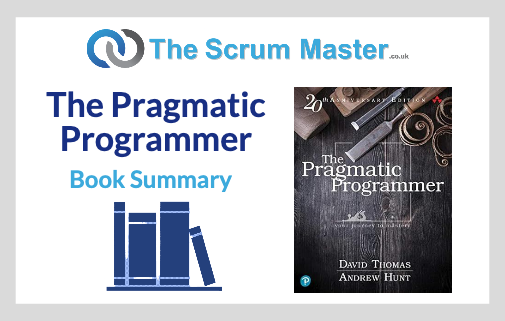
The Pragmatic Programmer: Your Journey to Mastery by Andrew Hunt and David Thomas is one of the most respected and influential books in software development. First published in 1999 and later updated for its 20th anniversary, it offers timeless lessons on how to think, act and grow as a professional programmer. Rather than focusing on specific technologies or tools, it provides practical guidance on mindset, habits and craftsmanship — the skills that make developers effective, adaptable and valuable in any environment.
The book’s central idea is that great programmers are not defined by their technical knowledge alone but by how they approach their work. Pragmatic programmers take responsibility, learn continuously, communicate clearly and focus on delivering high-quality software that solves real problems. The advice applies as much to agile teams and modern development as it did when the book was first written.
The Pragmatic Mindset
At its core, being pragmatic means being realistic, thoughtful and adaptable. The authors describe the pragmatic programmer as a problem-solver who balances theory and practice, understands the bigger picture and makes smart trade-offs rather than following rigid rules.
One of the first principles introduced is the idea of taking responsibility for your work. Pragmatic programmers do not make excuses or blame others when things go wrong. They own their decisions, learn from mistakes and find ways to improve. This mindset builds trust with colleagues and leads to better outcomes.
The authors also introduce the concept of “broken windows,” borrowed from urban psychology. In software, a “broken window” might be a piece of messy code, an ignored test failure or a poor design decision left unaddressed. If small problems are tolerated, they signal that quality doesn’t matter, and soon the entire system deteriorates. The pragmatic approach is to fix small issues early and maintain pride in your work.
This ties closely to the idea of care and craftsmanship. Software is not just code; it is a product of creativity, logic and design. Developers should view themselves as craftspeople, constantly refining their skills and striving for excellence in both design and execution.
The Importance of Communication
Another recurring theme in the book is communication. Many software failures are not technical but human — caused by misunderstandings, assumptions or lack of clarity. Pragmatic programmers recognise that communication is part of their job, not an optional extra.
They communicate early, clearly and often. This includes writing readable code, documenting decisions and discussing risks openly. They also understand their audience — whether speaking to other developers, project managers or customers — and adjust their message accordingly.
The authors emphasise that written communication in code is just as important as spoken communication. Code should be self-explanatory, consistent and expressive. Comments should explain why something was done, not just what it does. Good communication through code reduces friction, improves collaboration and makes systems easier to maintain.
The DRY Principle: Don’t Repeat Yourself
One of the book’s most famous principles is DRY — Don’t Repeat Yourself. Duplication is one of the biggest sources of bugs and technical debt. When the same logic or information is repeated across multiple places, any change must be made everywhere, increasing the risk of inconsistency and error.
The DRY principle encourages developers to centralise knowledge and logic. If something changes, it should change in one place. This applies not just to code but to processes, documentation and data structures.
However, the authors warn against applying DRY blindly. The goal is not to eliminate all repetition but to eliminate duplication of knowledge. Sometimes small, intentional repetition can improve clarity or reduce dependencies. Pragmatic thinking means balancing simplicity with maintainability.
Orthogonality: Decoupling and Independence
The concept of orthogonality, borrowed from mathematics, refers to keeping components independent so that changes in one part of a system do not affect others. In programming, orthogonal systems are easier to understand, modify and test.
For example, a database layer should not depend on the specifics of the user interface. If the UI changes, the database should not need to. Similarly, functions and modules should have clear, single responsibilities. This separation of concerns reduces complexity and makes software more robust.
The authors point out that orthogonality also applies to teams. Cross-functional teams that can operate independently — without constant coordination across silos — move faster and make better decisions. This aligns perfectly with agile principles and modern DevOps practices, where autonomy and collaboration drive efficiency.
Tracer Bullets and Iterative Development
Before agile methodologies became mainstream, The Pragmatic Programmer was already advocating iterative, feedback-driven development. The authors use the metaphor of “tracer bullets” — a military technique where bullets are coated with a material that glows in flight, allowing shooters to adjust aim based on where they land.
In software, tracer bullets represent small, working pieces of functionality built early to test assumptions, validate design choices and provide immediate feedback. Instead of spending months designing in isolation, pragmatic programmers build iteratively, learning and adjusting as they go.
This approach is at the heart of agile and lean development today. By delivering value incrementally and getting feedback early, teams reduce risk and increase alignment with user needs. Tracer bullets also demonstrate progress and keep morale high by producing tangible results quickly.
Prototyping to Learn
Closely related to tracer bullets is the idea of prototyping. Prototypes are quick, disposable models used to explore ideas, test hypotheses and uncover unknowns. Pragmatic programmers use prototypes to learn, not to build production systems.
Prototyping helps clarify requirements, evaluate technologies and identify problems before committing to a full implementation. It is a form of experimentation that saves time in the long run. However, the authors caution against the temptation to turn a prototype into production code — this often leads to poor architecture and technical debt.
In agile environments, this principle manifests as spikes or exploratory work that informs future development. It supports a learning culture where experimentation is valued over premature perfection.
Design by Contract and Defensive Programming
The authors introduce the concept of “design by contract,” a technique where software components explicitly define their responsibilities, inputs, outputs and error conditions. Each part of the system guarantees certain behaviours, just like a legal contract.
This clarity of responsibility makes systems more reliable and easier to debug. When something fails, it is clear which contract was broken. Combined with defensive programming — anticipating potential errors and handling them gracefully — this approach creates robust software that fails predictably rather than catastrophically.
In modern terms, this mindset is similar to using clear API contracts, automated tests and well-defined interfaces between components. The idea is to make assumptions explicit and verify them continuously.
The Power of Automation
Automation is another cornerstone of pragmatic development. Anything that can be automated should be. Repetitive manual tasks — such as builds, deployments or testing — waste time and introduce human error. Automating these processes increases reliability and frees developers to focus on creative problem-solving.
The authors encourage creating scripts and tools to simplify workflows. A pragmatic programmer should build an environment that supports productivity. This might include automating builds, creating reusable templates, or writing scripts to handle frequent tasks.
Today, this principle underpins continuous integration and continuous delivery (CI/CD) pipelines. The idea of automating repetitive tasks to increase quality and speed has become central to modern DevOps culture.
Testing Early and Continuously
Testing is not a separate phase but an integral part of development. The book emphasises testing early, testing often and automating as much as possible. Pragmatic programmers view tests as safety nets that allow them to refactor and evolve the code confidently.
Rather than treating testing as a chore, they use it as a feedback mechanism. Tests validate assumptions, catch regressions and improve design. Writing tests first — an idea that later evolved into test-driven development (TDD) — forces developers to think through requirements and edge cases before coding.
The authors argue that the best time to find a bug is when it is introduced. Delayed testing increases cost and risk. The pragmatic approach is to make testing part of everyday development, not something left until the end.
Refactoring and Continuous Improvement
No software design is perfect from the start. Systems evolve, requirements change and understanding deepens over time. Refactoring — improving the structure of existing code without changing its behaviour — keeps systems healthy and adaptable.
The authors encourage continuous refactoring to remove duplication, simplify logic and clarify intent. They liken this to regular maintenance: if you don’t refactor regularly, technical debt accumulates and slows everything down.
The key is to make refactoring safe by using automated tests and version control. Each small improvement compounds over time, leading to cleaner, more maintainable systems. In agile terms, this reflects the principle of continuous improvement — always seeking better ways to deliver value.
Programming Pragmatically
The book offers many smaller lessons that together define a pragmatic approach to development. Developers should think ahead, anticipate change and design systems that are flexible. Hardcoding values, assuming specific environments or writing code that cannot adapt will cause problems later.
The authors introduce the idea of orthogonal knowledge — learning broadly and deeply. Pragmatic programmers read widely, experiment with different languages and technologies, and stay curious. They build “learning portfolios” to continually expand their skills, because technology changes but the underlying principles endure.
They also stress the importance of version control, clear naming conventions and automation — practices that are standard today but were groundbreaking when first introduced. Each of these habits contributes to professionalism and efficiency.
Another key idea is estimating and managing uncertainty. Pragmatic programmers are honest about unknowns and communicate them clearly. They avoid overpromising and instead focus on delivering incremental progress and visibility. This transparency builds trust with stakeholders and aligns perfectly with agile’s empirical, feedback-driven approach.
From Code to Craftsmanship
What sets The Pragmatic Programmer apart is its focus on mindset and professionalism rather than technology. It encourages developers to think like craftsmen — taking pride in their work, learning from experience and helping others grow. The authors advocate sharing knowledge, mentoring colleagues and contributing to a culture of excellence.
They remind readers that software development is fundamentally a creative and collaborative discipline. Great code is not just technically correct but readable, elegant and maintainable. Pragmatic programmers balance idealism with practicality, always aiming to deliver value without losing sight of quality.
In many ways, the book predicted the rise of agile, DevOps and continuous delivery. Its principles of iteration, feedback, automation and communication are now cornerstones of modern development. Yet its lessons remain timeless because they focus on people and thinking, not on frameworks or tools.
The Pragmatic Programmer remains essential reading for anyone in software development — from beginners to seasoned professionals. It is a reminder that excellence is not achieved through perfection but through continuous learning, care and curiosity.