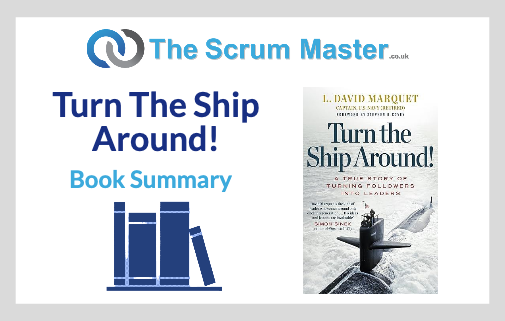
Turn The Ship Around! by L. David Marquet is a powerful story about leadership transformation, empowerment and trust. Set aboard the USS Santa Fe, a nuclear-powered submarine in the US Navy, the book tells how Marquet turned one of the worst-performing crews into one of the best by rejecting traditional command-and-control leadership. His approach replaced obedience with ownership, creating a culture where every crew member thought and acted like a leader. The result was a high-performing, self-managing team that could operate effectively even in the absence of direct supervision.
Although rooted in a military context, the lessons are deeply relevant to organisations of all types, especially those adopting agile and self-organising approaches. Marquet’s story shows that the key to exceptional performance lies not in stronger commands but in creating an environment where people are trusted to think, decide and act.
From Command and Control to Empowerment
When David Marquet was assigned to command the USS Santa Fe, he faced a serious problem. The submarine had the worst morale and performance in the fleet. It was plagued by low retention, mistakes and a culture of compliance. Sailors did what they were told, but they did not take initiative or responsibility.
Marquet had trained for a different submarine, so when he took command of the Santa Fe, he did not know all the details of its systems. In one early incident, he gave an order that could not be executed because the system on this particular vessel did not support it. The officer repeated the order anyway, knowing it was wrong. When Marquet asked why, the officer replied, “Because you told me to.” This moment changed everything. Marquet realised that a culture of blind obedience had stripped his crew of independent thought.
From that day, he vowed to create leaders, not followers. Instead of giving orders, he shifted to giving intent. He called this the “leader-leader” model, in contrast to the traditional “leader-follower” approach that dominates most organisations. By empowering his crew to make decisions and take responsibility, he aimed to unleash their intelligence, creativity and commitment.
The Power of Intent-Based Leadership
Intent-based leadership became the foundation of the Santa Fe’s transformation. The principle is simple: the leader sets direction and purpose, while the team decides how to achieve it. Instead of waiting for permission, team members state their intentions. For example, instead of asking, “What should I do?” they would say, “I intend to submerge the ship.” The leader’s role shifts from giving instructions to ensuring that the intent aligns with the mission and values.
This small linguistic change had a profound psychological impact. It forced people to think, plan and take ownership of their actions. Responsibility moved from the top down to every level. The crew stopped executing blindly and started acting intelligently. Marquet calls this moving decision-making authority to “where the information is,” rather than keeping it at “where the authority is.”
In agile teams, this principle mirrors the empowerment of self-organising teams. When people closest to the work have the authority to decide, decisions are faster and better informed. Trust grows, and accountability strengthens because people own the outcomes.
Giving Control, Not Taking It
A common misconception about leadership is that control equals strength. Marquet dismantles this idea. True leadership, he argues, means giving control, not taking it. When leaders cling to control, they create dependency. People stop thinking for themselves and rely on approval before acting. This may feel safe in the short term but leads to stagnation and low morale.
By giving control, leaders create engagement. Marquet’s challenge was to give control safely. On a nuclear submarine, reckless decisions could be catastrophic, so he had to build competence and clarity first. Control without competence is chaos. Competence without clarity leads to confusion. To succeed, the team needed both.
He introduced training to deepen technical knowledge and constant reinforcement of purpose and values. This combination created a framework within which people could make autonomous decisions aligned with the mission.
The balance between control, competence and clarity applies equally in business. Agile leaders who empower teams must also invest in developing their skills and ensuring shared understanding of goals. Freedom works best when it operates within clear boundaries of trust and purpose.
Building Competence and Confidence
Marquet understood that empowerment is meaningless without competence. If people do not know how to perform their roles effectively, giving them autonomy only increases risk. He therefore made continuous learning central to the Santa Fe’s culture.
He encouraged officers and crew members to understand systems beyond their immediate responsibilities. Sailors began studying the mechanics of operations, questioning assumptions and cross-training in different areas. Knowledge became shared rather than hoarded.
This learning culture built both skill and confidence. As sailors became more competent, they made better decisions. They stopped waiting for approval and started acting on intent. Each success reinforced the belief that leadership could be distributed safely and effectively.
In agile organisations, a similar dynamic occurs when teams invest in continuous learning and improvement. Regular retrospectives, shared knowledge and technical mastery give teams the confidence to make decisions and take ownership. Competence becomes the foundation for empowerment.
Clarity of Purpose
While competence builds confidence, clarity provides direction. Marquet ensured everyone on the Santa Fe understood not just what they were doing but why. He constantly communicated the ship’s mission and how each person’s role contributed to it.
This sense of purpose helped align individual decisions with organisational goals. When everyone shares the same understanding of success, centralised control becomes unnecessary. People can act autonomously because they know what the right outcome looks like.
Clarity also strengthens accountability. When intent is explicit, and the team knows the mission, everyone can see whether actions align with it. Marquet’s crew began to think strategically rather than mechanically, anticipating needs and preventing errors before they occurred.
In agile environments, clarity of purpose is critical. Teams thrive when they understand the product vision, customer value and success metrics. When clarity is missing, autonomy can lead to misalignment. Marquet’s message is clear: empower people, but give them a compass.
Communication and Language Matter
Language was one of the most powerful tools in Marquet’s transformation. He recognised that the words leaders use shape culture and behaviour. Traditional military language reinforces hierarchy and obedience. By changing language, he changed thinking.
Phrases like “I intend to…” encouraged ownership. Replacing “request permission” with “state intent” redefined the relationship between leader and subordinate. Similarly, eliminating terms like “they” or “them” when referring to other departments created unity.
Marquet also promoted open questioning. Instead of giving answers, he asked questions that encouraged reflection and learning. This approach not only built understanding but also developed leadership qualities in others.
In agile teams, the same principle applies. Leaders who shift their language from command to collaboration create more engaged and proactive teams. Simple phrases like “What do you think?” or “How would you approach this?” can transform a conversation and build shared ownership.
Overcoming Resistance
Transforming the Santa Fe’s culture was not easy. Many sailors were used to simply following orders and feared the consequences of taking initiative. Marquet tackled this by starting small and proving success through action. Each time a crew member took initiative and succeeded, trust grew.
He also modelled the behaviour he wanted to see. By admitting when he did not know something, he demonstrated humility and encouraged learning. He made it clear that mistakes were opportunities for improvement, not punishment.
Over time, the crew realised that their leader genuinely trusted them. They responded by taking responsibility and striving for excellence. The change was gradual but permanent.
Leaders in any field will face similar resistance when trying to empower teams. People conditioned to follow will hesitate to lead. Marquet’s experience shows that patience, consistency and visible results are key to breaking old habits and building new confidence.
Measuring Success and Sustaining Change
Within a year, the USS Santa Fe went from the worst to the best-performing submarine in the fleet. Retention rates soared, operational errors dropped, and morale improved dramatically. More importantly, the culture of empowerment endured long after Marquet’s departure.
This sustainability is one of the book’s most impressive aspects. Many leadership transformations fade when the leader leaves, but on the Santa Fe, the systems and mindset remained. Officers who served under Marquet went on to command other submarines and apply the same model, spreading the culture of empowerment throughout the Navy.
Sustaining change, Marquet explains, requires embedding leadership at every level. Systems and rituals must reinforce the behaviours you want to see. In his case, this included regular discussions of intent, transparent decision-making and shared accountability.
In agile organisations, sustainability comes from embedding principles in processes like sprint reviews, retrospectives and shared ownership of outcomes. When leadership becomes a collective responsibility, it no longer depends on one individual.
Lessons for Agile and Modern Leadership
Marquet’s story offers several lessons that resonate strongly with agile ways of working. First, empowerment must be real, not symbolic. Teams need the authority to make meaningful decisions and the competence to do so effectively.
Second, clarity and purpose are essential. Without them, autonomy turns into chaos. Leaders must ensure everyone understands the mission and the principles guiding decisions.
Third, continuous learning and feedback create resilience. Marquet’s crew thrived because they reflected on performance, learned from mistakes and improved continuously. Agile teams that adopt similar habits build adaptability and trust.
Finally, leadership is a shared act, not a position. Every team member can and should lead in their own domain. This collective ownership creates high-performing, self-managing teams capable of navigating complexity and change.
Turn The Ship Around! is a book about empowerment, but it is also about responsibility. When people are trusted to lead, they rise to the occasion. When leaders focus on creating more leaders rather than followers, organisations become more adaptable, innovative and human.
The transformation of the USS Santa Fe is proof that when leaders give intent, not orders, they unlock potential far beyond what traditional management can achieve. It is a reminder that great leadership is not about control but about creating the conditions where others can excel.