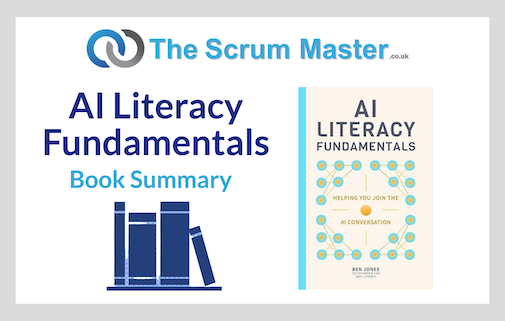
Ben Jones’ AI Literacy Fundamentals is a beginner-friendly guide designed to empower readers to understand and engage meaningfully in conversations about artificial intelligence (AI). Through relatable metaphors, accessible language, and a balanced tone, the book demystifies AI, presenting it not as an overwhelming technical challenge but as a vital and navigable domain in the modern world. The work is split into three parts: an introduction to AI, the core technologies underpinning it, and the broader considerations and implications.
Swimming Toward the Wave
Jones begins with a personal metaphor—learning to swim toward waves rather than away from them—to illustrate the necessity of confronting rather than avoiding AI. As AI continues to advance, those unwilling to understand it risk becoming obsolete, a reality highlighted through Mark Cuban’s stark warning: “Otherwise you’re going to be a dinosaur within three years.” The book is intended as a foundation—especially for those starting from scratch—enabling readers to engage confidently in AI-related discussions and decisions.
Understanding AI: Definitions and Types
The first section tackles the surprisingly slippery task of defining AI. Jones traces its origin to John McCarthy’s 1955 definition as “the science and engineering of making intelligent machines.” However, he quickly notes that “intelligence” itself is a vague term, ranging from a dog’s intuition to a child’s exam performance to tree communication systems. AI definitions vary—from dictionary entries to legislation like the U.S. National Artificial Intelligence Initiative Act to definitions generated by ChatGPT itself. Common themes emerge: perception, reasoning, prediction, and decision-making—particularly tasks historically performed by humans.
He distinguishes between strong AI (or Artificial General Intelligence—AGI), which remains theoretical and aims to emulate full human cognitive ability, and weak AI (or Artificial Narrow Intelligence—ANI), which is everywhere and handles specific tasks like face recognition or language translation. Jones also introduces General Purpose AI (GPAI), a regulatory term emerging in the EU to describe adaptable, powerful AI models like GPT-4.
Importantly, Jones highlights the AI effect: as soon as AI achieves a task, we stop considering it “real” AI. From Deep Blue’s chess victory in 1997 to today’s virtual assistants and spam filters, what once seemed cutting-edge quickly becomes mundane.
A Brief History of AI
Jones takes readers through a rapid historical journey. While tales of intelligent machines date back to Greek myths like Talos and Chinese automatons, the formal inception of AI began in the mid-20th century. Alan Turing’s famous 1950 paper introduced the “imitation game”—now called the Turing Test—as a way to assess a machine’s ability to exhibit intelligent behaviour indistinguishable from a human’s. Though still debated and not definitively passed, the test remains a cornerstone of AI history.
The Dartmouth Workshop of 1956, led by McCarthy and others, marked the birth of AI as a field. From that point, AI experienced cycles of optimism (AI springs) and disillusionment (AI winters). Symbolic AI (based on hardcoded rules) dominated the early years with systems like Logic Theorist and General Problem Solver. Joseph Weizenbaum’s ELIZA—a simple rule-based chatbot that mimicked a therapist—astounded people with its humanlike interaction, despite having no understanding of the content.
But high expectations led to disappointment. Promises of intelligent machines performing human-level tasks by the 1980s proved overly ambitious. The rise and fall of expert systems—programs that used logic rules to mimic expert decision-making—illustrated this cycle. For example, DEC’s R1 system successfully configured computer systems, but limitations in adaptability and scalability led to another AI winter by the early 1990s.
Core Technologies: Machine Learning and Deep Learning
The second part of the book focuses on the modern engines of AI advancement: machine learning (ML) and deep learning. Jones explains that rather than being explicitly programmed, machine learning algorithms learn from data. For example, instead of teaching a computer the exact features of a cat, you provide it with thousands of images of cats and non-cats, allowing it to discern patterns.
He explores supervised, unsupervised, and reinforcement learning as the three primary ML paradigms. In supervised learning, models are trained on labelled data (e.g., emails marked as spam or not); in unsupervised learning, they find hidden patterns without labels (like customer segmentation); and in reinforcement learning, agents learn through trial and error (e.g., playing video games or controlling robots).
Deep learning is a more powerful and flexible subset of machine learning that uses neural networks with multiple layers—so-called “deep” networks. Inspired loosely by biological neurons, these models adjust internal weights to maximise correct predictions. Deep learning is responsible for recent advances in computer vision, language understanding, and generative models.
Jones explains how this shift from symbolic, rule-based systems to data-driven, pattern-based systems has fuelled AI’s rapid development in the last decade. He also highlights that neural networks power many of today’s generative tools, including ChatGPT and DALL·E.
Applications of AI in Everyday Life
One of the book’s greatest strengths is its grounding in everyday examples. Jones lists several commonplace applications to show that AI isn’t just a futuristic dream but already deeply embedded in our lives. Streaming services like Netflix use AI-powered recommendation engines to predict what you’ll watch next. Virtual assistants like Siri and Alexa convert voice commands into actions via speech recognition and natural language processing.
Facial recognition is now standard on smartphones, with increasingly reliable results even when a person changes their appearance. Email platforms use AI to filter spam, learning from user feedback. Google Translate and similar tools offer real-time language translation, enabled by powerful models trained on multilingual data.
Jones also delves into generative AI, which surged in popularity with the launch of ChatGPT in late 2022. These systems can produce humanlike text, images, audio, and even video. Their capabilities raise important questions about creativity, authorship, and fairness, which he explores further in the third section.
Ethical and Societal Considerations
In Part Three, Jones moves from technical to ethical terrain, exploring AI’s benefits and risks. The benefits include increased efficiency, new tools for creativity, improved accessibility, and enhanced decision-making in fields like healthcare and logistics. But the concerns are serious: job displacement, algorithmic bias, misinformation, and surveillance are all growing problems.
He stresses that AI systems reflect the data they’re trained on. If historical data contains biases, the AI will replicate and amplify them. This is particularly worrying in high-stakes areas like hiring, lending, and law enforcement. Misuse of facial recognition technologies has already been documented, with higher error rates for certain demographics.
Jones calls for more inclusive AI development. It’s not enough for a handful of technologists to decide how AI works or who benefits. Broad participation—from different backgrounds, cultures, and disciplines—is essential to steer AI in a direction that serves society as a whole.
The final chapter addresses common AI myths and misconceptions. No, AI is not sentient. No, it won’t become superintelligent overnight. And no, it’s not magic. By clearing up such myths, Jones aims to bring clarity and encourage informed discourse.
AI Literacy: A Civic Duty
The book concludes by positioning AI literacy as a modern-day civic skill. Just as reading and numeracy became essential in previous centuries, the ability to understand and critically evaluate AI is now vital. AI literacy isn’t just about knowing how the tech works—it’s about understanding its impacts, questioning its outputs, and contributing to the societal conversation.
Importantly, Jones argues that AI literacy depends on data literacy. Since AI is built on data, understanding where data comes from, how it’s processed, and what it means is essential to evaluating AI systems. The two literacies are interdependent, and both are necessary for anyone who wants to thrive in a world increasingly shaped by intelligent machines.
Final Thoughts
AI Literacy Fundamentals does what few tech books manage to do—it respects the reader’s intelligence without requiring technical expertise. It’s optimistic but not naïve, comprehensive without being bloated. Jones invites everyone to the table, not just engineers and scientists. With clear structure, vivid examples, and a grounded tone, this book offers a valuable primer on the AI revolution that is already shaping our lives.
Whether you want to participate in workplace discussions, navigate AI tools responsibly, or simply understand the forces shaping the modern world, this book equips you with the language and conceptual tools to do so. And in doing that, it might just help you swim toward the wave—before it crashes over you.