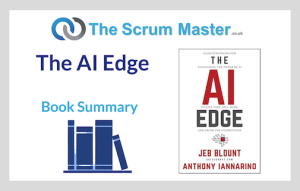
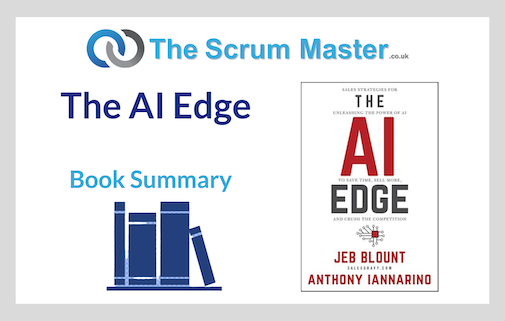
In The AI Edge, Jeb Blount and Anthony Iannarino offer a timely and practical guide for sales professionals on integrating artificial intelligence into the sales process. Rather than a technical manual, this book serves as a hands-on sales playbook focused on increasing efficiency, boosting pipeline results, and amplifying human strengths using AI.
Foundations: The Case for AI in Sales
The book opens with a compelling argument: sales is not going away—it’s evolving. While AI is rapidly transforming the business world, it doesn’t replace human salespeople. Instead, it enhances their capabilities. The authors dismantle the myth that AI will take over selling, asserting that the real winners will be those who blend human emotional intelligence, creativity, and rapport-building with the power of AI.
The Human Advantage
Blount and Iannarino highlight that the core of selling remains deeply human. Trust, intuition, and emotional intelligence (EQ) are what make the difference in complex sales. AI cannot replace the nuanced reading of human emotions, unspoken concerns, or the deep personal relationships that drive long-term customer success. AI should handle data, logistics, and automation—freeing humans to focus on what they do best: connect, persuade, and influence.
The Four Intelligences of Modern Sales
A central concept introduced is the Four Elements of Sales Intelligence:
IQ (Innate Intelligence): Your natural cognitive ability. It’s fixed, but it supports rapid learning.
AQ (Acquired Intelligence): The knowledge and skills you develop. This is where training, reading, and experience come in.
EQ (Emotional Intelligence): Your ability to manage your own emotions and respond to others’. This is the differentiator in building lasting relationships.
TQ (Technological Intelligence): Your ability to adopt and apply technology, particularly AI, into your workflow.
These four intelligences don’t operate in silos—they amplify each other. High-performing salespeople excel across all four.
The Three A’s: Adopt, Adapt, Adept
To get started with AI, the authors introduce a simple but powerful framework:
Adopt: Embrace emerging technologies early. Waiting too long means falling behind.
Adapt: Shape AI tools around your unique sales process rather than conforming to generic solutions.
Adept: Practice and refine your usage until you’re proficient. Mastery won’t happen overnight.
Salespeople are urged to start small—automate one task, measure the results, and scale from there. The goal is incremental improvement, not perfection.
Practical AI Applications in Sales
The core of the book is dedicated to exploring specific areas of the sales cycle where AI can drive the most impact.
Prospecting
Prospecting is described as the area where AI offers the biggest time savings. AI can:
-
Build dynamic, intent-driven prospect lists.
-
Analyse online behaviour to predict buying windows.
-
Personalise messaging at scale.
-
Automate follow-ups without losing context or tone.
But caution is offered: don’t let AI fully take over. The book warns against becoming an “asynchronous seller”—one who hides behind tech and avoids real human contact. AI should open doors; it’s the human who walks through them.
Time Management and Planning
One of the standout sections focuses on using AI to regain control of your calendar. High performers don’t let the day happen to them—they plan it with surgical precision. AI can assist with:
-
Prioritising tasks.
-
Suggesting optimal meeting slots.
-
Highlighting high-value prospects.
-
Automating calendar and CRM updates.
The takeaway: use AI to eliminate admin work so you can focus on actual selling.
Pre-Call Research & Discovery
AI excels at research. It can scour company websites, social profiles, and news feeds to provide:
-
Organisational insights.
-
Stakeholder data.
-
Industry trends.
-
Suggested discovery questions.
This not only saves time but arms the salesperson with conversation starters and relevant context, increasing the odds of a high-impact meeting.
Presentations and Proposals
Creating proposals is tedious. AI can handle formatting, content generation, and even customisation. It ensures consistency and saves hours each week. More advanced tools even offer predictive scoring—estimating the likelihood of success based on historic deal data.
Communication and Writing
Blount and Iannarino dedicate a section to using AI as your writing partner. While humans bring authenticity and tone, AI can help by:
-
Drafting first versions.
-
Catching grammar and spelling errors.
-
Offering alternative phrasing.
-
Speeding up content editing and refinement.
But a human editor is still necessary to polish and personalise. AI speeds things up—it doesn’t replace the human voice.
Social Selling and Content
Salespeople must engage on platforms like LinkedIn. AI can help with:
-
Content curation.
-
Writing insightful commentary.
-
Suggesting hashtags and post timing.
There are AI-powered social tools that analyse engagement data and score your posts for potential reach and virality.
Discovery, Qualifying & Closing
This section reinforces that AI cannot replace sound sales fundamentals. Tools can prepare you, but you still need to:
-
Ask the right questions.
-
Listen actively.
-
Manage objections.
-
Navigate stakeholders.
AI can support this by simulating objection handling, generating competitive analysis, or analysing call transcripts. But the moment of truth—when it’s time to close—is still deeply human.
The Future of Sales
The authors end with a strong call to action. AI will reshape sales, but not in a way that sidelines salespeople. Instead, it will:
-
Augment human capabilities.
-
Shift focus to strategic, relationship-driven work.
-
Elevate the profession for those who evolve.
Salespeople who embrace the change, develop their four intelligences, and apply AI wisely will not only survive but thrive.
Final Thoughts
The AI Edge is a fast-paced, no-nonsense guide that meets salespeople where they are. It doesn’t bog readers down in technical detail. Instead, it offers frameworks, principles, and actionable advice. The message is clear: you don’t need to be a data scientist to use AI—you just need the right mindset and a willingness to evolve.
For anyone in sales trying to figure out where to begin with AI, this book is your first and most important step. Adopt it, adapt it, and get adept—or get left behind.