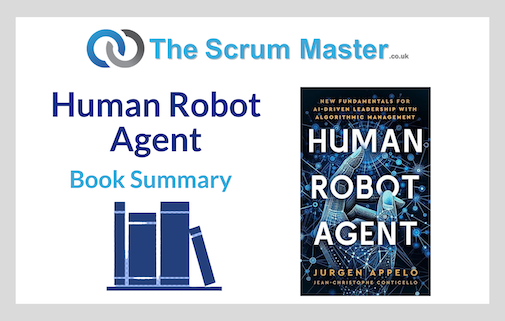
Jurgen Appelo’s Human Robot Agent is a bold exploration of how artificial intelligence, robotics, and digital agents are reshaping the foundations of work, leadership, and society. The book is not a speculative meditation on AI but a practical blueprint for navigating the Fourth Industrial Revolution. Appelo weaves together insights from organisational design, agile practices, complexity science, and management innovation, presenting a framework for thriving in an era where human, robotic, and algorithmic teammates must collaborate.
The opening sections set the tone with urgency. AI, Appelo argues, is not a distant horizon but an immediate force altering industries, professions, and the rules of competition. Unlike past technological shifts, AI moves at an exponential pace. History shows that those who embrace paradigm shifts—whether electricity, the internet, or now AI—become leaders, while laggards fade into irrelevance. Readers are warned that they have two choices: adapt and master AI as a tool for leverage, or cling to outdated practices and risk obsolescence. The stakes are framed starkly: there is no middle ground.
The first major part of the book examines new ways of working in the age of AI. At the personal level, AI transforms how individuals work, shifting their roles from executing tasks to orchestrating and collaborating with digital agents. Humans must cultivate new skill sets—critical thinking, ethical judgment, creativity, and adaptability—while offloading repetitive or analytical work to machines. Teams are also reshaped. Where once cross-functional groups of humans were essential, smaller human crews enhanced by AI can often outperform larger teams in both speed and quality. Dynamic, swarm-like configurations replace rigid hierarchies, and co-intelligence—where humans and machines complement each other’s strengths—becomes the new norm. At the organisational level, structures flatten, bureaucracy is challenged, and management increasingly takes the form of algorithmic optimisation. Executives must recognise that they cannot retire from progress; they must lead by example, embracing AI as a lever for effectiveness rather than simply a cost-cutting tool. The “executive imperative” is to motivate, reskill, and reframe their organisations around AI-driven value creation.
The second part of the book turns to change and what comes after Agile. Appelo reflects on the many failed transformation initiatives that companies have pursued under banners such as digitalisation, lean, and agile. While methodologies and frameworks have come and gone, the underlying drivers remain the same: the need for innovation, engagement, and efficiency. What is different now is the vocabulary and the tools. Organisations may no longer ask explicitly for “Agile coaches” but instead demand expertise in data, AI, and agents. Appelo stresses that the fundamental medicine remains agility, but it must be administered in a language and form aligned with contemporary needs. He situates current shifts in waves of change—from industrial mechanisation, through digitalisation, through agile and lean practices, and now into the era of AI and agents. To survive, organisations must continue the journey of simplification, adaptability, and systemic redesign, with AI as both catalyst and companion.
The third part addresses the challenge of taming wicked problems—complex, interdependent issues without simple solutions. Appelo introduces complexity thinking, drawing from systems theory and highlighting how traditional linear approaches fail in unpredictable environments. He presents the Wicked Framework, built around MARVIS, as a practical tool for navigating complexity. MARVIS encourages leaders to consider multiple perspectives, adapt continuously, and embrace diversity and resilience in their systems. Progress in a wicked world does not come from solving problems definitively but from making iterative advances while learning from feedback. The message is clear: in the AI age, leaders must abandon the illusion of control and instead cultivate anti-fragile organisations that thrive on uncertainty.
In the fourth part, Appelo explores AI-infused patterns and principles. Tools, methods, and frameworks remain essential, but they are now augmented by AI-driven pattern libraries. Patterns for decision-making, innovation, and discovery can be codified, simulated, and enhanced by intelligent systems. For example, AI can run rapid simulations of customer behaviours, prototype product designs, or evaluate multiple decision frameworks at speeds beyond human capacity. Humans retain the final say, but the role shifts from making every decision to setting boundaries, delegating authority, and integrating AI insights. Appelo also revisits the classic distinction between discovery and delivery, emphasising that AI can accelerate discovery processes by generating ideas, surfacing anomalies, and identifying opportunities, while humans anchor delivery with judgment and accountability. New principles for the age of AI emerge, emphasising transparency, responsibility, and augmentation rather than replacement.
The fifth and final part reimagines management for the AI era. Appelo argues that management is too important to be left only to those with the title of “manager.” Everyone—human, robot, and agent alike—must take ownership of managing tasks, relationships, and responsibilities. Bad management is not the result of a few incompetent leaders but of collective neglect of communication, clarity, and accountability. In this light, everyone becomes a manager, orchestrating their own interactions with human and digital colleagues. The role of formal management shifts toward providing purpose, values, and responsible AI principles. Appelo outlines new fundamentals: cultivating purpose that resonates in an AI-driven world, embedding values that ensure ethical and sustainable use of technology, and embracing transparency and accountability. He advocates for ten core values as the basis of responsible AI, including accountability, transparency, sustainability, and engagement. These values, he notes, should aim higher than human behaviour itself, setting aspirational standards for machines that mirror what humans often fail to achieve.
Appelo is not naïve about the risks. He recognises the anxieties of workers who fear replacement, the ethical dilemmas of bias and accountability, and the potential erosion of human skill through over-reliance on machines. He urges caution against unwise strategies such as replacing junior staff with AI, which undermines future talent pipelines, or delegating entirely to machines without keeping humans in the loop. He stresses the importance of wisdom over mere knowledge. AI may provide limitless information and insights, but humans must bring judgment, morality, and purpose to bear. The future, he suggests, is less about knowing and more about cultivating wisdom that machines cannot replicate.
The conclusion ties these strands together by introducing the concept of Management 3000 (M3K). If Management 3.0 was Appelo’s agile approach to leadership, M3K represents the next evolution, untethered from version numbers and grounded in the enduring need to adapt, unfix, and reimagine management in the AI era. He calls for a new sociological-technological dance where success depends on mastering both social and technical dimensions. Those who can blend patterns, principles, and practices across human and digital domains will thrive; those who cannot will struggle to keep pace.
Throughout the book, Appelo peppers his analysis with case studies, anecdotes, and playful dialogue with his AI co-writers such as “Zed.” This interplay underscores his central thesis: the future is not about humans versus machines but about humans with machines. He frames AI as a collaborator, not a competitor, and invites readers to imagine their digital colleagues not as faceless algorithms but as named and valued teammates. Anthropomorphising AI agents, he suggests, makes the transition less threatening and more accessible, easing the cultural shift towards blended teams of human and non-human workers.
The ethical dimension runs as a constant thread. Issues of bias, transparency, accountability, and sustainability are not optional extras but central to building trust and ensuring that AI augments rather than diminishes humanity. Appelo champions engagement—designing AI systems that delight, surprise, and enrich human interaction—rather than cultivating suspicion and fear. He pushes for cognitive diversity, unlearning outdated models, and embracing feedback loops to stay adaptive in an ever-changing environment. The book is both pragmatic and idealistic, urging leaders to seize the opportunities of AI while holding themselves and their technologies to higher standards.
By the end, Human Robot Agent presents a vision that is both inspiring and demanding. It challenges individuals to embrace AI as a teammate, not a tool; organisations to cultivate adaptability and responsibility; and managers to see themselves not as controllers but as facilitators of purpose and values. It also recognises the profound philosophical questions AI raises about intelligence, sentience, and what it means to be human. While machines may soon outperform us in efficiency, accuracy, and information processing, they cannot replace our capacity for wisdom, empathy, and ethical judgment. The task ahead is to shape a future where those qualities define our collaboration with technology.
The book closes on a provocative note: the future of work is neither purely social nor purely technological but a blend of both. Success will come to those who master this sociological-technological dance, while failure awaits those who resist or oversimplify. With humour, clarity, and urgency, Appelo provides not just another management book but a call to action for leaders, workers, and organisations navigating the age of AI. It is at once a survival manual, a manifesto, and a hopeful roadmap for building a world where humans, robots, and agents collaborate to create something greater than any could achieve alone.