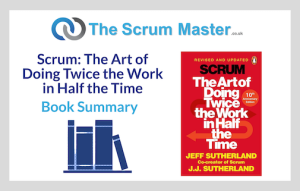
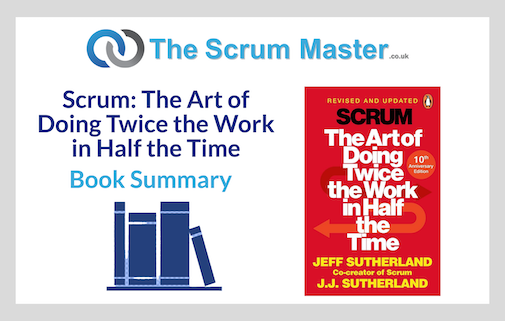
In Scrum: The Art of Doing Twice the Work in Half the Time, Jeff Sutherland, the co-creator of Scrum, offers a compelling account of how this lightweight framework revolutionised the way teams deliver results. The book blends practical insights, case studies, and stories from business, the military, and education to demonstrate how Scrum enables teams to achieve more by focusing on collaboration, transparency, and continuous improvement.
Sutherland’s central message is simple: most organisations waste time, talent, and energy on inefficient processes. Scrum is the antidote, designed to maximise value while eliminating waste. The method has transformed everything from software development at Google to operations at the FBI, from managing startups to tackling global humanitarian projects.
The Origins of Scrum
Scrum was born out of frustration with traditional project management. As a software engineer and former US Air Force pilot, Sutherland saw first-hand how hierarchical command structures slowed decision-making. When he entered the tech world, he found a similar problem. Projects ran late, quality suffered, and teams were demoralised.
Inspired by lean manufacturing and the Toyota Production System, Sutherland realised that successful teams shared a few key traits. They worked in small, cross-functional units, focused on clear goals, and delivered frequently. Drawing on ideas from complex adaptive systems and empirical process control, he and Ken Schwaber formalised Scrum in the 1990s as a way to make work visible, feedback fast, and improvement constant.
The Core of Scrum
Scrum is built around short, focused iterations called sprints, usually lasting one to four weeks. Each sprint begins with a planning session, where the team decides what they can deliver, and ends with a review and retrospective, where they inspect results and identify ways to improve. Three roles form the backbone of Scrum: the Product Owner, the Scrum Master, and the Development Team.
The Product Owner represents the customer and prioritises the work that delivers the most value. The Scrum Master ensures the team follows Scrum principles, removes obstacles, and fosters a culture of continuous improvement. The Development Team is self-organising and cross-functional, taking collective responsibility for delivering potentially shippable increments at the end of each sprint. Scrum works because it embraces reality. Instead of pretending to predict the future with detailed plans, it builds learning and adaptation into every cycle. Each sprint provides a small but valuable opportunity to test ideas, validate assumptions, and adjust course based on evidence.
Doing Less to Achieve More
Sutherland challenges the myth that working longer or harder leads to better results. In fact, multitasking, overcommitment, and long hours reduce productivity. Scrum focuses instead on doing less but finishing it fully. By limiting work in progress and concentrating on the most important items, teams deliver value faster and with fewer mistakes. This principle mirrors the lean concept of flow — value moves efficiently from idea to customer when distractions and bottlenecks are eliminated. The mantra of Scrum is “stop starting and start finishing.” Each sprint is a chance to deliver something tangible rather than getting stuck in endless analysis or partially completed work.
The Power of Teams
Scrum relies on small, autonomous teams. Sutherland argues that the ideal team size is seven, plus or minus two. Larger groups introduce communication overhead and slow decision-making. Each team member brings different skills, and their success depends on collaboration, not individual performance. The Scrum Master ensures that the environment supports this teamwork, removing impediments and fostering open communication. Trust and transparency are vital. Daily Scrums (or stand-up meetings) allow everyone to share what they’ve done, what they’ll do next, and what’s blocking them. This rhythm keeps the team aligned and prevents problems from festering.
Planning through Empiricism
In traditional project management, planning is often rigid and predictive. Scrum flips this on its head. Plans in Scrum are adaptive, based on evidence from previous sprints. Instead of committing to massive scope and fixed deadlines, Scrum teams forecast progress using velocity — the average amount of work completed per sprint. This data-driven approach makes estimates more realistic and removes the false certainty of upfront planning. By delivering small, testable increments, teams can validate assumptions early. If something isn’t working, they can pivot quickly. As Sutherland notes, “The only failure is the failure to learn fast enough.”
Transparency, Inspection, and Adaptation
These three principles underpin everything in Scrum. Transparency ensures that progress and problems are visible to all. Inspection happens through regular reviews and retrospectives. Adaptation means acting on what the team learns. The retrospective, held at the end of each sprint, is one of the most powerful aspects of Scrum. It gives the team a structured opportunity to discuss what worked, what didn’t, and what to improve next. Continuous improvement becomes part of the culture, not an occasional exercise.
The Role of the Scrum Master
Many organisations misunderstand the Scrum Master role, assuming it’s a rebranded project manager. In truth, the Scrum Master is a servant leader who empowers the team rather than directing it. Their primary responsibility is to help the team work more effectively — coaching them in Scrum practices, removing impediments, and protecting them from unnecessary interference. The Scrum Master ensures that Scrum principles are upheld and that the team continuously refines its process. Sutherland compares the role to that of a sports coach. The Scrum Master doesn’t play the game but helps the team play at its best.
Measuring What Matters
Scrum emphasises measuring outcomes rather than outputs. Traditional performance metrics often reward activity instead of impact. For example, measuring lines of code or hours worked encourages waste. Instead, Scrum focuses on value delivered to the customer. The Product Owner constantly reorders the backlog to ensure the team is working on the most valuable items. Regular reviews with stakeholders ensure that the team remains aligned with customer needs. This customer-centric focus creates a feedback loop that drives innovation. Sutherland recalls how at Google, small Scrum teams experimented continuously, measuring user engagement and adapting features quickly.
Scrum Beyond Software
Although Scrum originated in software, Sutherland shows how it can be applied anywhere. He shares examples from diverse fields, including education, defence, and healthcare. The FBI, for instance, used Scrum to rescue a failing IT project that had been in development for years with no results. By adopting Scrum, they broke the work into small, deliverable pieces and delivered usable functionality within months. Similarly, in education, teachers have used Scrum principles to improve collaboration and student engagement. Even in personal life, individuals use Scrum boards and sprints to manage goals more effectively.
Overcoming Organisational Resistance
One of the biggest challenges in adopting Scrum is cultural inertia. Many leaders struggle to let go of control, and traditional hierarchies resist self-organisation.
Sutherland argues that true agility requires trust and empowerment. Leaders must shift from managing people to managing systems — creating environments where teams can thrive. He advises starting small, demonstrating results, and expanding gradually. Once people see that Scrum delivers faster, better outcomes, momentum builds naturally. He also warns against “fake Scrum” — where organisations adopt rituals like stand-ups but retain old behaviours such as top-down control or fixed deadlines. Real Scrum requires embracing empiricism and empowerment, not just vocabulary.
The Science of High Performance
Sutherland draws on psychology and neuroscience to explain why Scrum works. Humans are motivated by autonomy, mastery, and purpose — the same drivers identified by Daniel Pink in Drive. Scrum provides all three. Teams are autonomous in how they deliver work, they continuously develop mastery through learning and feedback, and they are guided by a shared purpose in each sprint goal. This combination boosts engagement, creativity, and productivity. Sutherland cites studies showing that engaged teams can outperform disengaged ones by over 200 per cent.
Timeboxing and the Value of Focus
Timeboxing — limiting work to fixed time periods — is a core Scrum practice. It forces focus and discipline, preventing the endless drift common in traditional projects. Each sprint becomes a mini-project with a clear goal. The short duration ensures that feedback comes quickly, reducing risk and uncertainty. Timeboxing also helps build a rhythm that sustains motivation and momentum. Sutherland likens this to the concept of “flow” described by psychologist Mihaly Csikszentmihalyi — when people are deeply absorbed in challenging but achievable work. Scrum creates the conditions for flow by balancing autonomy with clear boundaries.
The Importance of Done
A key rule in Scrum is that work must be “done” at the end of each sprint. Done means potentially shippable — not half-finished or awaiting integration. This discipline eliminates the accumulation of technical debt and ensures consistent quality. Teams define their own Definition of Done, setting clear criteria for completion. By finishing work completely in each sprint, teams build trust with stakeholders and avoid the pitfalls of partial progress that never quite materialises into value.
Scrum as a Way of Thinking
More than a framework, Scrum represents a mindset. It encourages teams to embrace uncertainty, experiment fearlessly, and learn continuously. Sutherland urges readers to see Scrum as a way of thinking rather than a rigid process. The key is to deliver value frequently, inspect results honestly, and adapt rapidly. This mindset aligns closely with the empirical roots of Scrum — making decisions based on what is known rather than what is hoped. It’s about replacing guesswork with learning.
Real-World Results
Throughout the book, Sutherland provides striking examples of Scrum’s impact. A Japanese car manufacturer improved efficiency by 300 per cent. A US Army initiative reduced project time by half. Startups used Scrum to outpace competitors with far fewer resources. Even in humanitarian projects, Scrum proved its worth. Sutherland’s own work with the World Bank and international NGOs showed that the same principles could accelerate progress in tackling poverty and disaster response.
The Future of Work
Sutherland concludes that the future belongs to adaptive organisations that learn faster than their competitors. Bureaucracy, rigid planning, and fear of change are relics of the industrial age. Scrum offers a model for the modern world — fast, flexible, and focused on outcomes. It turns uncertainty into opportunity by making learning the engine of progress.
For Scrum Masters, Product Owners, and teams alike, the message is clear: focus on value, shorten feedback loops, and never stop improving. The result is not just more productivity, but more meaningful work.